


Speech: talking and listening


 About this lesson
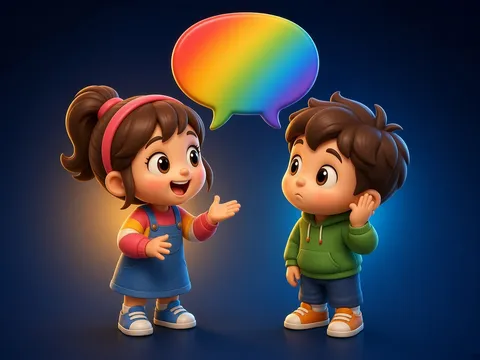
Speech is sharing thoughts in words. Good speakers are also good listeners.
 What the book shows

The textbook usually presents the topic with a big picture, a short example and 2–3 tasks. Look at the page together and talk about the picture.
Textbook link:
This is not the textbook’s text but a short description of the topic. Check the exact page in your own textbook.
 The lesson step by step
- 1
Greeting5 min
Everyone greets a neighbour.
On the boardSalam! - 2
Picture talk10 min
What is happening? In full sentences.
- 3
“Microphone”10 min
Only the one holding the object speaks.
- 4
Magic words10 min
Role plays: at the shop, at school.
- 5
Wrap-up5 min
Three rules of a good listener.
 Let’s understand
For the student Simple language
We talk every day: we greet, ask and tell. But a conversation takes two: one talks, the other listens.
Magic words
Salam! · Xahiş edirəm · Sağ ol · Bağışla · Hələlik!
Hello · Please · Thank you · Sorry · Bye
 For the parent
How to help
- Each evening ask “What was the best part of today?” and listen to the end.
- If the answer is one word, ask for a full sentence.
- Use polite words yourself; children learn by example.
 For the teacher
 Lesson goals
- Oral speech and listening skills.
- Speech etiquette.
How to teach it
- Picture talk, role play.
 Differentiation
- For shy pupils: talk in pairs first.
 Questions for the class
- Why not interrupt?
 How to check
The pupil speaks in 3 full sentences and retells what was heard.
 Scientific Scientific language
Kinds of speech
There is oral speech (speaking and listening) and written speech (reading and writing). Grade 1 focuses on oral speech: saying a thought in a full sentence, telling things in order, listening and understanding.
Techniques
- Talking about a picture.
- The “microphone” game: only the one holding the object speaks.
- Retelling what was heard.
Self-study
Step by step
- Before speaking, think: what do I want to say?
- Say it clearly in a full sentence.
- When listening, look at the speaker and wait.
- Ask a question at the end.
Going deeper
 Scientific language: for older students, parents and teachers.
In linguistics, speech is language in use: language is a system of words and rules, speech is that system used in a real conversation. Listening is active too: the listener remembers, understands and prepares a reply.
Politeness formulas (greeting, thanks, apology) exist in every language, and children pick them up mainly from adults’ example.
 Play and check
Does a good listener do this or not?
 How to write it down
- Write the magic words: salam, sağ ol.
- Write one sentence about yourself.
How the classwork looks in the notebook
Sample: the date and heading follow this country’s notebook rules.
 Watch out: common mistakes
 Where it helps in life
- Reading: listening skills help with understanding texts.
- Presentations: talking in front of the class.
 At home
Core
- Tell your family about today in 3 sentences.
- Say “please” and “thank you”.
Challenge ⭐
- Listen to a story from a grandparent and retell it.
How to do it
- Count your 3 sentences on your fingers first.
- A family member listens and asks one question.
Answers for parents
Answers vary. Check: are the sentences full and in order?
Step-by-step homework solution — Show the solution (try it yourself first)
3 sentences
- What happened? Where? How did it end? One sentence each.
Listening
- Afterwards, repeat one detail you heard.
How the homework looks in the notebook
Sample: the date and heading follow this country’s notebook rules.

 About cookies