


Who am I?


 About this lesson
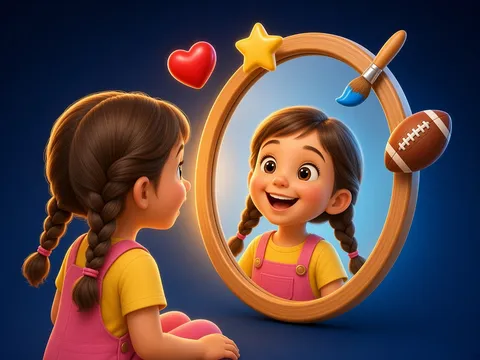
Every person is unique, with their own name, face, voice and interests. Knowing yourself is the first step to understanding others.
 What the book shows

The textbook usually presents the topic with a big picture, questions and a small practical task. Talk about the picture and link the questions to your child’s life.
Textbook link:
This is not the textbook’s text but a short description of the topic. Check the exact page in your own textbook.
 The lesson step by step
- 1
Mirror5 min
What do we see in the mirror?
- 2
Introductions10 min
Introducing ourselves in a circle.
- 3
Feelings10 min
Emotion cards.
- 4
Portrait10 min
Drawing self-portraits.
- 5
Wrap-up5 min
I am unique because…
 Let’s understand
For the student Simple language
The girl looks in the mirror and smiles. She knows herself!
My name is … · I am … years old.
My eyes are …
I like …: drawing, ball games, songs…
My feelings
 happy ·
 sad ·
 angry ·
 scared
All feelings are normal. Putting them into words helps: “I feel sad because…”
 For the parent
How to help
- Look at baby photos together: “Look how you’ve grown!”
- In the evening ask “How did you feel today?”
- Name your child’s strengths: “You are very patient.”
 For the teacher
 Lesson goals
- Introducing oneself, naming feelings.
How to teach it
- Circle time, emotion cards, portraits.
 Differentiation
- Shy pupils: speak in pairs first.
 Questions for the class
- Why are we all different?
 How to check
The pupil says 3 sentences about themselves and names 4 feelings.
 Scientific Scientific language
Self-awareness
At 6–7 children start to describe themselves more clearly: looks, skills, interests. Naming feelings (emotional literacy) helps them manage behaviour. The topic also teaches respect for difference: we are all different, and that is fine.
Self-study
Step by step
- Say your name and age.
- Describe how you look.
- Name 3 things you love.
- Say how you feel today.
Going deeper
 Scientific language: for older students, parents and teachers.
Psychology often lists basic emotions such as joy, sadness, fear, anger, surprise and disgust. Being able to recognise and name feelings helps children’s relationships and learning.
Every person’s fingerprints are unique, even identical twins’ differ: a nice example of “everyone is special”.
 Play and check
Is this a feeling or how someone looks?
 How to write it down
- Draw your self-portrait.
- Write your name and age under it.
How the classwork looks in the notebook
Sample: the date and heading follow this country’s notebook rules.
 Watch out: common mistakes
 Where it helps in life
- My family: I am part of a family.
- Friendship: understanding others’ feelings.
 At home
Core
- Make an “About me” card: name, age, favourite colour, favourite game.
Challenge ⭐
- Ask your family what you were like as a baby. Tell one story.
How to do it
- Make the card colourful.
- Present it to your family.
Answers for parents
Answers are personal. Check: does your child speak in full sentences?
Step-by-step homework solution — Show the solution (try it yourself first)
Introduce yourself
- 3 sentences: name, age, something you love. Look at your listeners.
How the homework looks in the notebook
Sample: the date and heading follow this country’s notebook rules.

 About cookies