


Behaviour rules

 About this lesson
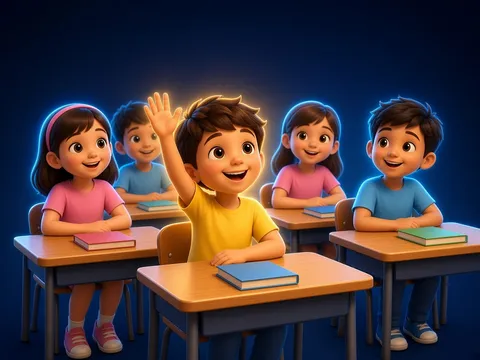
Behaviour rules help everyone learn well and stay safe. Polite words show respect.
 What the book shows

The textbook usually presents the topic with a big picture, questions and a small practical task. Talk about the picture and link the questions to your child’s life.
Textbook link:
This is not the textbook’s text but a short description of the topic. Check the exact page in your own textbook.
 The lesson step by step
- 1
Picture5 min
What is the child doing?
- 2
Rules10 min
Class rules poster.
- 3
Magic words10 min
Game: find the right word.
- 4
Role play10 min
Situations.
- 5
Wrap-up5 min
Which rule matters most?
 Let’s understand
For the student Simple language
The pupil wants to speak and raises a hand.
 I raise my hand to speak.
 I listen to the teacher and classmates.
 I am quiet during lessons.
 I walk, not run, in the corridor.
In Azerbaijani: salam · xahiş edirəm · sağ ol · bağışlayın · hələlik
 For the parent
How to help
- Use the “magic words” at home too.
- Take turns to speak in family conversations.
- Praise good behaviour straight away.
 For the teacher
 Lesson goals
- Class rules, politeness.
How to teach it
- Poster, role play, sorting.
 Differentiation
- Show rules with pictures.
 Questions for the class
- What would a lesson be like without rules?
 How to check
The pupil names 3 rules and 5 polite words.
 Scientific Scientific language
Self-control
Following rules needs self-control: waiting, taking turns to speak. At 6–7 this skill is still developing, so short, positive rules (“walk” rather than “don’t run”) work better.
Self-study
Step by step
- Name 3 class rules.
- Say 5 magic words.
- Why do we need these rules?
Going deeper
 Scientific language: for older students, parents and teachers.
Educators recommend writing rules together with children: when they help create a rule, they follow it more readily.
A positive wording (“walk”, “speak quietly”) is remembered better than a ban (“don’t run”, “don’t shout”) because it tells the child what to do.
 Play and check
Is this good behaviour?
 How to write it down
- Draw a raised hand.
- Write: “I raise my hand.”
How the classwork looks in the notebook
Sample: the date and heading follow this country’s notebook rules.
 Watch out: common mistakes
 Where it helps in life
- Road safety rules.
- Public behaviour: museums, transport.
 At home
Core
- Count how many times you say magic words in a day.
Challenge ⭐
- Make up 3 rules for a library or a bus.
How to do it
- Draw a tally mark each time.
- Count them in the evening.
Answers for parents
Example: in the library speak quietly, look after books, return them on time.
Step-by-step homework solution — Show the solution (try it yourself first)
Situation
- You need a classmate’s pencil. What do you say? “Could I borrow your pencil, please?”
How the homework looks in the notebook
Sample: the date and heading follow this country’s notebook rules.

 About cookies