


Our holidays


 About this lesson
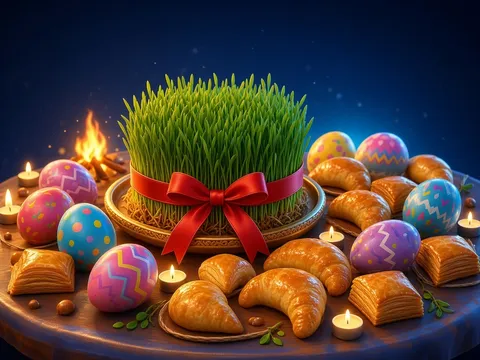
A holiday is a day when people celebrate together. Some are linked to nature (Novruz), some to our history (Independence Day, Victory Day), some to religion (Ramadan, Gurban).
 What the book shows

The textbook usually presents the topic with a big picture, questions and a small practical task. Talk about the picture and link the questions to your child’s life.
Textbook link:
This is not the textbook’s text but a short description of the topic. Check the exact page in your own textbook.
 The lesson step by step
- 1
Picture5 min
What’s on the table?
- 2
Novruz10 min
4 Tuesdays, customs.
- 3
Calendar10 min
Marking the holidays.
- 4
Game10 min
Holiday and season.
- 5
Wrap-up5 min
My favourite holiday…
 Let’s understand
For the student Simple language
A Novruz table: səməni (sprouted wheat) with a red ribbon, painted eggs, shekerbura and pakhlava, candles and a bonfire.
 Novruz
The festival of spring’s arrival and nature waking up. Before Novruz four Tuesdays (çərşənbə) are marked: Water, Fire, Wind and Earth. People grow səməni, paint eggs, jump over bonfires and leave a hat at a neighbour’s door.
1 January: New Year
March: Novruz
28 May: Independence Day
8 November: Victory Day
9 November: National Flag Day
31 December: Day of Solidarity of World Azerbaijanis
The dates of Ramadan and Gurban holidays change every year.
 For the parent
How to help
- Sprout səməni together 2–3 weeks before Novruz.
- Share your family’s holiday traditions.
- Colour-code holidays on a calendar.
 For the teacher
 Lesson goals
- Main holidays, Novruz customs, calendar.
How to teach it
- Picture, growing wheat, calendar.
 Differentiation
- Respect different family customs.
 Questions for the class
- Why is Ramadan on a different day each year?
 How to check
The pupil names 3 holidays with dates and 2 Novruz customs.
 Scientific Scientific language
Holidays and calendars
Novruz is tied to the spring equinox (around 20–21 March), a solar date. Ramadan and Gurban follow the lunar calendar; a lunar year is about 11 days shorter than a solar one, so these holidays move earlier each year.
Self-study
Step by step
- Name 3 holidays.
- Name the 4 Novruz Tuesdays.
- What do we do at Novruz?
 Terms in this lesson
Tap an underlined word — its meaning opens in the glossary.
- Season
- One of the four parts of the year.
Going deeper
 Scientific language: for older students, parents and teachers.
In 2009 Novruz was inscribed on UNESCO’s list of the Intangible Cultural Heritage of Humanity; Azerbaijan was among the countries that nominated it. In 2010 the UN declared 21 March International Nowruz Day.
The hat custom: children leave a hat at a neighbour’s door and hide, and the hosts fill it with sweets.
 Play and check
Which season is this holiday in?
 How to write it down
- Draw a tray of sprouted wheat with a red ribbon.
- Write: “Novruz”.
How the classwork looks in the notebook
Sample: the date and heading follow this country’s notebook rules.
 Watch out: common mistakes
 Where it helps in life
- History: independence and Victory.
- Reading: poems about Novruz.
 At home
Core
- Soak some wheat on a plate and grow səməni. Check it every day.
Challenge ⭐
- Draw your family’s favourite holiday and describe its customs.
How to do it
- Spread the wheat in a thin layer.
- Add a little water every day.
Answers for parents
The wheat sprouts in a few days and becomes green səməni in about 1–2 weeks. Don’t overwater it.
Step-by-step homework solution — Show the solution (try it yourself first)
Calendar
- How many days after Victory Day is Flag Day? 1 day (8 and 9 November).
How the homework looks in the notebook
Sample: the date and heading follow this country’s notebook rules.

 About cookies