


What is information?


 About this lesson
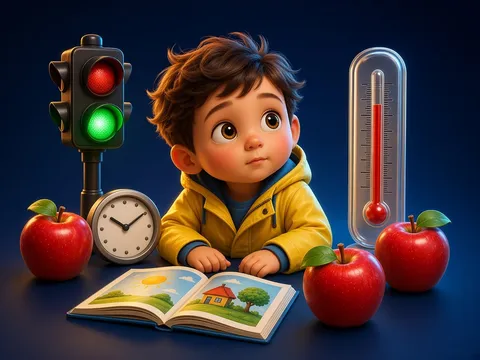
Information is anything that tells us something. A clock tells the time, a thermometer the temperature, a traffic light when to cross, a book a story.
 What the book shows

In computer science the child first learns to think through unplugged games: recognising information, ordering steps and learning safety rules.
Textbook link:
This is not the textbook’s text but a short description of the topic. Check the exact page in your own textbook.
 The lesson step by step
- 1
Warm-up5 min
A mystery sound: what is it?
- 2
New topic10 min
What is information?
- 3
Practice10 min
Find information in the picture.
- 4
Game10 min
“What does it tell?” game.
- 5
Wrap-up5 min
Look for information at home.
 Let’s understand
For the student Simple language
What in the picture gives information?
| Thing | What it tells us |
|---|---|
| Clock | the time |
| Thermometer | how hot or cold it is |
| Traffic light | whether we may cross |
| Book | a story, knowledge |
 For the parent
How to help
- Find 5 things at home that give information.
- Ask: what does it tell us?
- Watch the weather forecast together in the morning.
 For the teacher
 Lesson goals
- Understand what information is and spot things around us that give information.
How to teach it
- Unplugged games, cards, role play, discussion
 Differentiation
- Weaker pupils: 2–3 steps; stronger pupils build their own algorithm
 Questions for the class
- What is information? Give 3 examples.
 How to check
The pupil names 3 sources of information.
 Scientific Scientific language
Information is everywhere
An alarm clock, a rain cloud, mum’s voice: all are information. People receive, store, pass on and use it.
Computers work with information too
A computer also receives, stores and processes information, following people’s instructions.
Self-study
Step by step
- Look at the thing.
- Ask yourself: what does it tell me?
- Say the answer in words.
 Terms in this lesson
Tap an underlined word — its meaning opens in the glossary.
- Information
- What we know about the world around us.
- Algorithm
- A sequence of steps that reaches a goal.
Going deeper
 Scientific language: for older students, parents and teachers.
Long ago people sent information over long distances with smoke, fire and drums. Today phones and the internet do it in seconds.
 Play and check
What does it tell us about?
 How to write it down
- Draw 3 things that give information.
- Write what each one tells us.
How the classwork looks in the notebook
Sample: the date and heading follow this country’s notebook rules.
 Watch out: common mistakes
 Where it helps in life
- How we get information: sight, hearing
- Picture, text, sound
 At home
Core
- Find 5 things at home that give information.
Extra ⭐
- Find 2 signs in the street that give information.
How to do it
- Do the task with a grown-up.
- Explain in words what you noticed.
Answers for parents
For example: a clock, a thermometer, a calendar, a phone, a book; in the street a traffic light and a road sign.
Step-by-step homework solution — Show the solution (try it yourself first)
Think
- What does a doorbell tell us? Someone has come.
How the homework looks in the notebook
Sample: the date and heading follow this country’s notebook rules.

 About cookies