


Writing a short story


 About this lesson
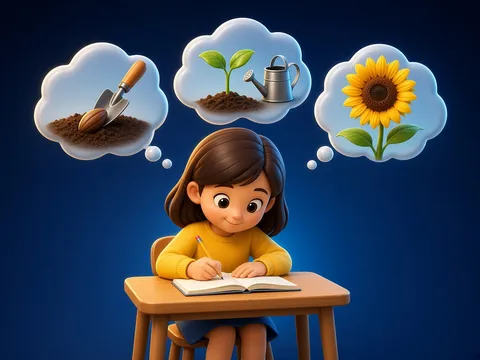
Every story has a beginning (who, where), a middle (what happened) and an end (how it finished).
 What the book shows

The textbook usually gives a short rule, example words or a text, then 3–4 tasks. Read the rule together, say the examples aloud, then do the tasks in the notebook.
Textbook link:
This is not the textbook’s text but a short description of the topic. Check the exact page in your own textbook.
 The lesson step by step
- 1
Pictures5 min
Three pictures, one story.
- 2
Plan10 min
Beginning, middle, end.
- 3
Game10 min
Sort the sentences.
- 4
Writing15 min
4–5 sentences.
- 5
Wrap-up5 min
Reading the stories.
 Let’s understand
For the student Simple language
The girl is writing, and the clouds show her story: a seed is planted, it sprouts, and a sunflower grows.
1. Beginning: who? where? Leyla bağçada toxum əkdi.
2. Middle: what happened? O, hər gün toxumu suladı. Bir gün kiçik cücərti çıxdı.
3. End: how did it finish? Yayda bağçada böyük günəbaxan açdı. Leyla çox sevindi.
Helper words: bir gün (one day), sonra (then), birdən (suddenly), nəhayət (finally).
 For the parent
How to help
- Have them tell the story aloud first.
- Don’t correct while they write; check together afterwards.
- Let them read it to the family.
 For the teacher
 Lesson goals
- Story structure, sequence words.
How to teach it
- Picture series, plan, sorting.
 Differentiation
- Weaker pupils: 1 sentence per picture.
 Questions for the class
- What if we change the ending?
 How to check
The pupil writes a 4–5 sentence, 3-part story.
 Scientific Scientific language
The writing process
Writing is taught in stages: gather ideas, plan, draft, check, then copy neatly. A picture sequence is a good support in Year 2 because it makes the story structure visible.
Self-study
Step by step
- Who and where? Beginning.
- What happened? Middle.
- How did it end? End.
- Check capitals and full stops.
Going deeper
 Scientific language: for older students, parents and teachers.
The beginning–middle–end structure is ancient: Aristotle wrote in his Poetics that a good work needs a beginning, a middle and an end.
 Play and check
Which part of the story is this?
 How to write it down
- Draw 3 pictures: first, then, finally.
- Write 1–2 sentences for each.
How the classwork looks in the notebook
Sample: the date and heading follow this country’s notebook rules.
 Watch out: common mistakes
 Where it helps in life
- Year 3: narratives, letters.
- Year 4: planning, essays.
 At home
Core
- Write a 4-sentence story called «Mənim ən şən günüm» (My happiest day).
Challenge ⭐
- Draw 3 pictures for it and add a title.
How to do it
- Tell it first, then write it.
- Check at the end.
Answers for parents
Check: is there a beginning, middle and end? Does each sentence start with a capital and end with a mark?
Step-by-step homework solution — Show the solution (try it yourself first)
Plan to story
- Plan: 1) the cat climbed a tree; 2) it couldn’t get down; 3) dad brought it down. Story: <span lang="az">«Bir gün pişiyimiz ağaca çıxdı. O, düşə bilmədi və miyovladı. Nəhayət, atam nərdivanla onu düşürdü.»</span>
How the homework looks in the notebook
Sample: the date and heading follow this country’s notebook rules.

 About cookies