


Running games: the relay


 About this lesson

A relay is a team race: each runner does one part and hands the baton to the next. Put the baton into your teammate’s open palm; never throw it. The next runner waits behind the line until they have it. Run around the cone and back, without crossing into another team’s lane. Support your teammates even if you lose.
 What the book shows

In PE the child moves, plays and builds healthy habits. Every lesson starts with a warm-up and ends with calm exercises.
Textbook link:
This is not the textbook’s text but a short description of the topic. Check the exact page in your own textbook.
 The lesson step by step
- 1
Warm-up5 min
Warm-up jog.
- 2
New topic10 min
Relay rules.
- 3
Practice10 min
Baton passing practice.
- 4
Game10 min
Team relay.
- 5
Wrap-up5 min
Team cheers.
 Let’s understand
For the student Simple language
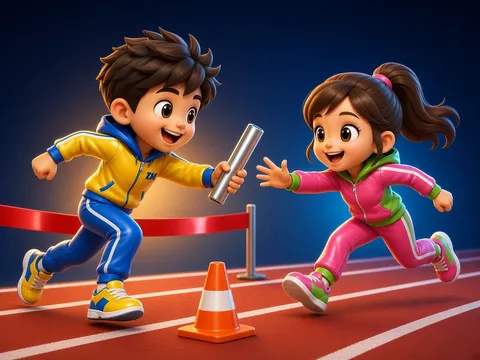
- 🏁 Wait behind the line.
- ✋ Your teammate puts the baton in your open palm.
- 🏃 Run and go round the cone.
- 🔁 Come back and hand the baton to the next runner.
- 🙌 Go to the back of the line and cheer your team.
 For the parent
How to help
- Hold a family relay outside using a paper roll as a baton.
- Ask your child to explain the rules.
 For the teacher
 Lesson goals
- Know relay rules: pass the baton properly, stay in your lane and run for your team.
How to teach it
- Warm-up, active games, demonstration, pair and team work
 Differentiation
- Weaker pupils: easier version and shorter distance; stronger pupils: an extra challenge
 Questions for the class
- How do we pass the baton and what are the relay rules?
 How to check
The pupil passes the baton correctly and follows the rules.
 Scientific Scientific language
Team power
Relays are won not by the fastest single runner but by the team that works best together; clean passes save time.
The Olympic relay
The Olympic Games include the 4 × 100 metres relay, where each of four runners covers 100 metres.
Self-study
Step by step
- Behind the line.
- Palm open.
- In my lane.
- Pass carefully.
- Cheer my team.
Going deeper
 Scientific language: for older students, parents and teachers.
Professional sprinters take the baton without looking back, which needs a signal and lots of practice.
 Play and check
In a relay, right or wrong?
 How to write it down
- Draw a relay plan: the line, a cone, 2 teams and arrows.
How the classwork looks in the notebook
Sample: the date and heading follow this country’s notebook rules.
 Watch out: common mistakes
 Where it helps in life
- Obstacle relays
- Starting commands
 At home
Core
- Play a two-team relay with your family.
Extra ⭐
- Invent a new relay (for example, carrying a ball).
How to do it
- Do the exercise in a safe place with a grown-up nearby.
- Then drink water and rest.
Answers for parents
For example: a potato-and-spoon relay or carrying a ball between your knees. The main rules stay the same: pass, wait, support.
Step-by-step homework solution — Show the solution (try it yourself first)
Think
- 4 runners each run 20 metres: the team runs 80 metres together.
How the homework looks in the notebook
Sample: the date and heading follow this country’s notebook rules.

 About cookies