


Safety at home


 About this lesson
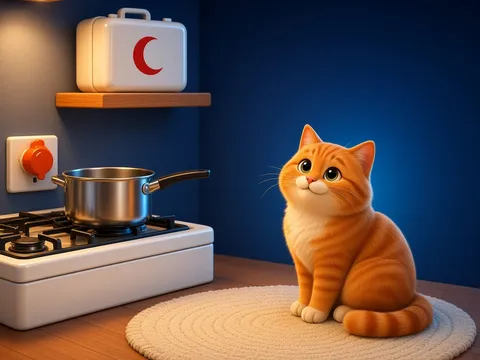
Home can be dangerous too. Never poke things into sockets, light the gas cooker on your own or take medicine without permission. If something is wrong, tell a grown-up at once and call an emergency number if needed.
 What the book shows

The textbook usually gives a big picture, questions and a small observation or project task. Talk about the picture, link the questions to your child’s life and continue the task at home.
Textbook link:
This is not the textbook’s text but a short description of the topic. Check the exact page in your own textbook.
 The lesson step by step
- 1
Kitchen5 min
All in place?
- 2
Dangers10 min
Electricity, gas, fire.
- 3
Game10 min
Safe or dangerous.
- 4
Numbers10 min
112, 101–104.
- 5
Practice5 min
Phone role play.
 Let’s understand
For the student Simple language
Everything in the kitchen is in its place: the pan handle is turned to the wall, the socket has a safety cover and the first-aid box is on a high shelf. The cat sits calmly on the rug.
| Number | Service |
|---|---|
| 112 | Emergencies (single number) |
| 101 | Fire service |
| 102 | Police |
| 103 | Ambulance |
| 104 | Gas emergency |
 For the parent
How to help
- Stick the emergency numbers on the fridge and learn your address together.
- Do a “danger hunt” at home: which places are risky?
- Keep medicine and cleaning products out of reach.
 For the teacher
 Lesson goals
- Home dangers and emergency numbers.
How to teach it
- Picture, sorting, role play.
 Differentiation
- Phone practice in class.
 Questions for the class
- Why is knowing your address important?
 How to check
The pupil knows the numbers and 3 rules.
 Scientific Scientific language
Why is it dangerous?
Electric current can pass through the body, so never touch appliances with wet hands. A gas leak has a smell: then don’t switch on lights or make a flame; open a window, leave the home and tell a grown-up. Medicine only helps in the dose a doctor gives.
Self-study
Step by step
- Could it burn, cut or shock?
- Do I need a grown-up’s permission?
- Choose: safe or dangerous.
Going deeper
 Scientific language: for older students, parents and teachers.
Natural gas has no smell of its own. A strong-smelling substance is added so that leaks are easy to notice. The “gas smell” is really a warning signal.
 Play and check
Safe or dangerous?
 How to write it down
- Write the emergency numbers and your address.
- Draw 3 risky places at home.
How the classwork looks in the notebook
Sample: the date and heading follow this country’s notebook rules.
 Watch out: common mistakes
 Where it helps in life
- Year 3: road safety.
- Year 4: online safety.
 At home
Core
- Do a danger hunt at home with a grown-up and write 3 rules.
Role play ⭐
- Practise calling 103 with a grown-up on a toy phone: name, address, what happened.
How to do it
- Only with a grown-up.
- Write the rules.
Answers for parents
For example: “I don’t touch sockets”, “Matches are for grown-ups”, “Medicine only with a grown-up”.
Step-by-step homework solution — Show the solution (try it yourself first)
What would you do?
- You smell smoke and the grown-ups are next door. Steps: get out, run to the neighbours, tell the grown-ups, and call 101 or 112 if needed.
How the homework looks in the notebook
Sample: the date and heading follow this country’s notebook rules.

 About cookies