


Our people’s traditions


 About this lesson
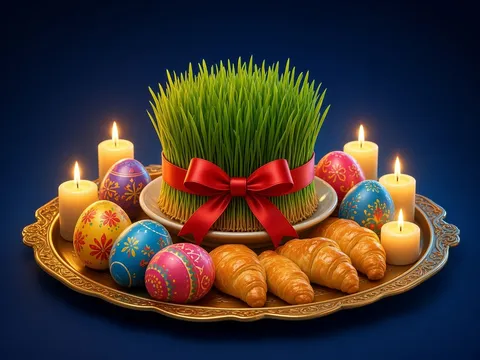
Traditions are customs and festivals handed down through the generations. Azerbaijan’s best-loved festival is Novruz, the arrival of spring. Hospitality, respect for elders, carpet weaving and mugham are also a treasured heritage.
 What the book shows

The textbook usually gives a big picture, questions and a small observation or project task. Talk about the picture, link the questions to your child’s life and continue the task at home.
Textbook link:
This is not the textbook’s text but a short description of the topic. Check the exact page in your own textbook.
 The lesson step by step
- 1
Festive tray5 min
What do we see?
- 2
Novruz10 min
The Tuesdays.
- 3
Game10 min
Novruz or not?
- 4
Heritage10 min
Carpets, mugham.
- 5
Family5 min
Our custom.
 Let’s understand
For the student Simple language
A festive tray: green wheat sprouts tied with a red ribbon in the middle, with painted eggs, sweets and candles around them. It looks like a Novruz table!
How is Novruz celebrated?
- Before the festival come four Tuesdays: the Tuesdays of Water, Fire, Wind and Earth.
- Wheat is sprouted as a symbol of new life.
- Families bake sweet pastries and paint eggs.
- Bonfires are lit, and relatives and neighbours visit each other.
 For the parent
How to help
- Sprout wheat together and water it every day.
- Ask grandparents about old customs.
- Bake festive sweets together.
 For the teacher
 Lesson goals
- Novruz and folk customs.
How to teach it
- Picture, sorting, interview.
 Differentiation
- Sprout wheat in class.
 Questions for the class
- Why keep traditions?
 How to check
The pupil names 3 Novruz customs.
 Scientific Scientific language
Intangible heritage
In 2009 Novruz, shared with several other countries, was added to UNESCO’s list of the Intangible Cultural Heritage of Humanity. The list also includes Azerbaijani mugham, the art of the ashiqs, carpet weaving and the silk headscarf craft. Novruz is linked to the spring equinox (20–21 March).
Self-study
Step by step
- Is it linked to Novruz?
- Is it on the festive table?
- Choose yes or no.
Going deeper
 Scientific language: for older students, parents and teachers.
In 2010 the UN General Assembly declared 21 March International Novruz Day. Novruz is celebrated not only in Azerbaijan but also in Central Asia, Iran, Türkiye and elsewhere, always as a festival of spring and nature waking up.
 Play and check
Is it a symbol of Novruz?
 How to write it down
- Write the 4 Tuesdays before the festival.
- Draw the festive table.
How the classwork looks in the notebook
Sample: the date and heading follow this country’s notebook rules.
 Watch out: common mistakes
 Where it helps in life
- Year 3: folk art and tales.
- Music: mugham and folk songs.
 At home
Core
- How does your family celebrate Novruz? Write 4 sentences.
Experiment ⭐
- Sprout wheat on a plate and watch it for 7 days.
How to do it
- Talk with your family.
- Write 4 sentences.
Answers for parents
For example: “We sprout wheat. Grandma bakes pastries. In the evening we light a bonfire. We take a festive tray to the neighbours.”
Step-by-step homework solution — Show the solution (try it yourself first)
Interview a grandparent
- Ask a grandparent 3 questions: how did you celebrate Novruz as a child? What games did you play? What was your favourite treat?
How the homework looks in the notebook
Sample: the date and heading follow this country’s notebook rules.

 About cookies