


Comparing numbers to 100


 About this lesson
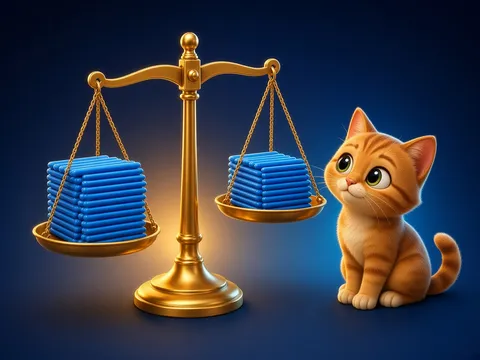
Compare the tens first: more tens means a bigger number. If the tens match, compare the ones.
 What the book shows

The textbook usually gives a picture example, a short rule and a few sums and word problems. Show the example with objects (sticks, cubes) first, then solve in the notebook.
Textbook link:
This is not the textbook’s text but a short description of the topic. Check the exact page in your own textbook.
 The lesson step by step
- 1
Scales5 min
Which side is heavier?
- 2
Rule10 min
Tens, then ones.
- 3
Game10 min
Pick the sign.
- 4
Order10 min
Smallest to biggest.
- 5
Wrap-up5 min
29 or 31: which is bigger?
 Let’s understand
For the student Simple language
The left pan has more rods, so it has sunk. The cat wonders: which side is heavier?
1. Compare the tens: 53 and 38 → 5 > 3, so 53 > 38.
2. If the tens match, compare the ones: 47 and 42 → 47 > 42.
Signs: > greater than, < less than, = equal. The open side faces the bigger number.
 For the parent
How to help
- Compare prices: which is cheaper?
- Play a card game: whose number is bigger?
- Ask for the reason: “because it has more tens”.
 For the teacher
 Lesson goals
- Comparing to 100.
How to teach it
- Scales, cards, sorting.
 Differentiation
- Weaker pupils: compare with sticks.
 Questions for the class
- Why is 30 > 29?
 How to check
The pupil compares 8 pairs correctly.
 Scientific Scientific language
Comparing by place
We start with the highest place because one ten beats any number of ones up to 9: 30 > 29. The same method works later for thousands and millions.
Self-study
Step by step
- Compare the tens.
- If equal, compare the ones.
- Write the sign and read it.
Going deeper
 Scientific language: for older students, parents and teachers.
The > and < signs were introduced in the 17th century by the English mathematician Thomas Harriot. The equals sign (=) was first used by Robert Recorde in 1557, who said nothing is more equal than two parallel lines.
 Play and check
Which sign is needed?
 How to write it down
- Write 6 pairs and add signs.
- Order from smallest: 47, 74, 40, 70, 44.
How the classwork looks in the notebook
Sample: the date and heading follow this country’s notebook rules.
 Watch out: common mistakes
 Where it helps in life
- Place value.
- Year 3: comparing to 1000.
 At home
Core
- Compare: 36 … 63, 58 … 55, 90 … 89, 41 … 41.
Challenge ⭐
- Using the digits 4 and 7, make the biggest and smallest two-digit numbers.
How to do it
- Circle the tens.
- Write the sign.
Answers for parents
36 < 63; 58 > 55; 90 > 89; 41 = 41. Challenge: 74 and 47.
Step-by-step homework solution — Show the solution (try it yourself first)
Books
- Leyla’s book has 46 pages, Murad’s has 64. Whose is thicker? 64 > 46, so Murad’s.
How the homework looks in the notebook
Sample: the date and heading follow this country’s notebook rules.

 About cookies