


Centimetres and metres


 About this lesson
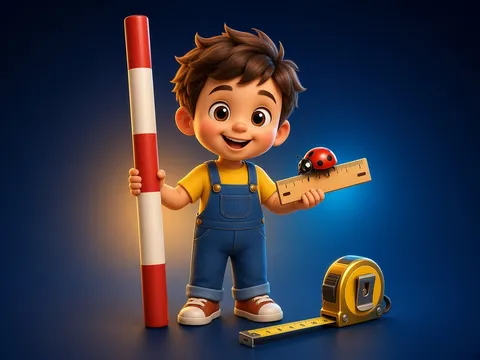
Centimetres (cm) are for short lengths like a pencil or book. Metres (m) are for long ones like a room or corridor. 1 m = 100 cm.
 What the book shows

The textbook usually gives a picture example, a short rule and a few sums and word problems. Show the example with objects (sticks, cubes) first, then solve in the notebook.
Textbook link:
This is not the textbook’s text but a short description of the topic. Check the exact page in your own textbook.
 The lesson step by step
- 1
Tools5 min
Ruler, tape, metre stick.
- 2
Centimetre10 min
Measure from zero.
- 3
Metre10 min
1 m = 100 cm.
- 4
Game10 min
Pick the unit.
- 5
Estimate5 min
Guess, then measure.
 Let’s understand
For the student Simple language
The boy measures with a metre stick while a ladybird walks along the ruler. Each tool has its own job!
Measuring with a ruler
- Line the end of the object up with 0.
- Look at the other end and read the number.
- Write the unit: 12 cm.
 For the parent
How to help
- Measure a spoon, pencil and book with a ruler.
- Use a tape measure for a table or door.
- Ask for a guess first, then measure.
 For the teacher
 Lesson goals
- cm, m, 1 m = 100 cm.
How to teach it
- Hands-on measuring, estimating, sorting.
 Differentiation
- Measuring in pairs.
 Questions for the class
- Why do we need a shared unit?
 How to check
The pupil measures 5 objects correctly.
 Scientific Scientific language
Units
The metre is the base unit of length in the International System of Units (SI). “Centi” means one hundredth: a centimetre is a hundredth of a metre. Measuring means finding how many times the unit fits along an object.
Self-study
Step by step
- Is it small or big? Choose the unit.
- Measure from zero.
- Write the number and the unit.
Going deeper
 Scientific language: for older students, parents and teachers.
The metre was created in France at the end of the 18th century, based on a fraction of Earth’s meridian. Today it is defined by the distance light travels in a vacuum in a set fraction of a second.
 Play and check
Which unit is handier?
 How to write it down
- Measure 5 objects and write: pencil … cm.
- Draw lines 4 cm, 7 cm and 10 cm long.
How the classwork looks in the notebook
Sample: the date and heading follow this country’s notebook rules.
 Watch out: common mistakes
 Where it helps in life
- Year 3: perimeter, millimetres and kilometres.
 At home
Core
- Compare: 1 m … 90 cm, 100 cm … 1 m, 1 m … 1 cm.
Challenge ⭐
- A ribbon was 1 m long and 35 cm was cut off. How many cm are left?
How to do it
- Hold the ruler straight.
- Write the unit.
Answers for parents
1 m > 90 cm; 100 cm = 1 m; 1 m > 1 cm. Challenge: 100 − 35 = 65 cm.
Step-by-step homework solution — Show the solution (try it yourself first)
Measure in steps
- Measure a corridor in steps, then with a tape. Why do people get different step counts? Steps differ, but a metre is the same for everyone.
How the homework looks in the notebook
Sample: the date and heading follow this country’s notebook rules.

 About cookies