


Crafts from leaves and seeds: modelling clay and natural materials


 About this lesson
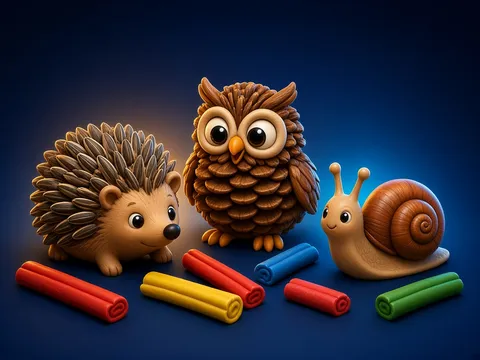
Modelling clay is soft and sticky: warm it in your hands, then roll, stretch and flatten it. Natural materials hold well when pressed into it. Hedgehog: push sunflower seeds into a clay body. Owl: stick clay eyes and a beak onto a pine cone. Snail: coil a clay sausage into a shell.
 What the book shows

In technology lessons the child works with their hands: cutting, folding, gluing and making things from natural materials. Every task starts with a safety rule.
Textbook link:
This is not the textbook’s text but a short description of the topic. Check the exact page in your own textbook.
 The lesson step by step
- 1
Warm-up5 min
Nature box.
- 2
New topic10 min
Clay and natural materials.
- 3
Practice10 min
Hedgehog or owl.
- 4
Game10 min
A forest scene.
- 5
Wrap-up5 min
Display and story.
 Let’s understand
For the student Simple language
| Figure | Clay | Natural material |
|---|---|---|
| 🦔 hedgehog | body, nose | sunflower seeds |
| 🦉 owl | eyes, beak | a pine cone |
| 🐌 snail | a coiled sausage | twigs for feelers |
 For the parent
How to help
- Collect cones, twigs and seeds in the park together.
- Set up a “forest animals” display at home.
 For the teacher
 Lesson goals
- Make animal figures by combining modelling clay with natural materials (seeds, pine cones, twigs).
How to teach it
- Demonstration, step-by-step making, pair work, a display
 Differentiation
- Weaker pupils work from a ready outline; stronger pupils make their own design
 Questions for the class
- How do we combine clay and natural materials?
 How to check
The pupil completes a figure and names its materials.
 Scientific Scientific language
Why warm the clay?
Hand warmth softens modelling clay; cold makes it hard.
Preparing materials
Collect cones and leaves from a clean, dry place; dry anything damp first.
Self-study
Step by step
- Choose materials.
- Warm the clay.
- Shape the base.
- Press in the natural parts.
- Wash my hands.
Going deeper
 Scientific language: for older students, parents and teachers.
Natural materials dry and change over time, so keep such crafts somewhere dry.
 Play and check
Natural or man-made?
 How to write it down
- Draw your figure and list the materials you used.
How the classwork looks in the notebook
Sample: the date and heading follow this country’s notebook rules.
 Watch out: common mistakes
 Where it helps in life
- Pressed leaves and leaf collage
- Working with clay
 At home
Core
- Make an animal from natural materials.
Extra ⭐
- Make up a story: what does it do in the forest?
How to do it
- Work with a grown-up watching.
- Tidy up afterwards.
Answers for parents
For example: a pine-cone owl, a walnut-shell tortoise, a spider with twig legs. The story should be 3–4 sentences.
Step-by-step homework solution — Show the solution (try it yourself first)
Plan
- A tortoise: a walnut shell for the shell, clay for the head and legs.
How the homework looks in the notebook
Sample: the date and heading follow this country’s notebook rules.

 About cookies