


Listening to our heart: pulse and effort


 About this lesson
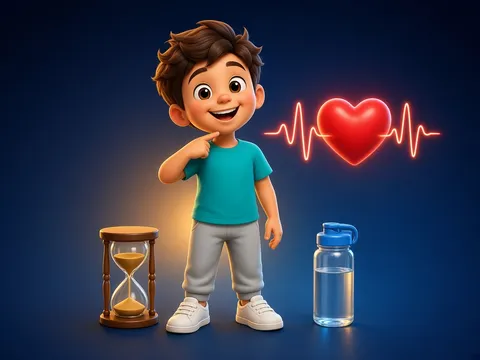
The heart pumps blood round the body, and we feel each beat at the neck and wrist as the pulse. Place two fingers (not your thumb!) gently at the side of the neck or on the inside of the wrist. Count for 15 seconds and multiply by 4 to get the beats per minute. After running and jumping your pulse rises a lot; when you rest it slows down again. After the lesson, drink a few sips of water, wash your hands and face and change out of sweaty kit.
 What the book shows

In PE the child moves, plays and builds healthy habits. Every lesson starts with a warm-up and ends with calm exercises.
Textbook link:
This is not the textbook’s text but a short description of the topic. Check the exact page in your own textbook.
 The lesson step by step
- 1
Warm-up5 min
Find your heartbeat.
- 2
New topic10 min
Counting the pulse.
- 3
Practice10 min
Run, then measure again.
- 4
Game10 min
Rest.
- 5
Wrap-up5 min
Water and hygiene.
 Let’s understand
For the student Simple language
| When? | 15 sec | × 4 | Per minute |
|---|---|---|---|
| 😌 sitting quietly | … | × 4 | … |
| 🏃 after 1 minute of running | … | × 4 | … |
| 🧘 after 2 minutes’ rest | … | × 4 | … |
 For the parent
How to help
- Measure your pulses together at home: sitting and after climbing the stairs.
- Pack a water bottle and towel in the PE bag.
 For the teacher
 Lesson goals
- Find and count your pulse at the neck or wrist, compare it before and after exercise, and know the rules for drinking water and washing afterwards.
How to teach it
- Warm-up, active games, demonstration, pair and team work
 Differentiation
- Weaker pupils: easier version and shorter distance; stronger pupils: an extra challenge
 Questions for the class
- How does exercise affect the heart?
 How to check
The pupil measures and calculates the pulse correctly and explains the change after exercise.
 Scientific Scientific language
Why the pulse rises
Working muscles need more oxygen, so the heart beats faster to bring them more blood.
The heart is a muscle
Regular exercise makes it stronger.
Self-study
Step by step
- Two fingers, not my thumb.
- Count 15 seconds and multiply by 4.
- Did my pulse go up after exercise?
- Water, then wash.
Going deeper
 Scientific language: for older students, parents and teachers.
Doctors check how the heart is working by taking the pulse, and athletes watch theirs during training.
 Play and check
Does the pulse go up or down?
 How to write it down
- Fill in the pulse table: resting, after running, after rest.
- When was your pulse highest?
How the classwork looks in the notebook
Sample: the date and heading follow this country’s notebook rules.
 Watch out: common mistakes
 Where it helps in life
- Pacing your effort
- Morning exercises
 At home
Core
- Measure and record your pulse morning and evening.
Extra ⭐
- Do 20 squats and measure again. How many minutes did it take to settle?
How to do it
- Do the exercise in a safe place with a grown-up nearby.
- Then drink water and rest.
Answers for parents
Answers vary. Usually the pulse rises after squats and returns close to its resting level after a few minutes’ rest.
Step-by-step homework solution — Show the solution (try it yourself first)
Calculate
- Resting: 20 × 4 = 80. After running: 35 × 4 = 140. Difference: 140 − 80 = 60 beats.
How the homework looks in the notebook
Sample: the date and heading follow this country’s notebook rules.

 About cookies