


Passing: the two-handed chest pass

 About this lesson
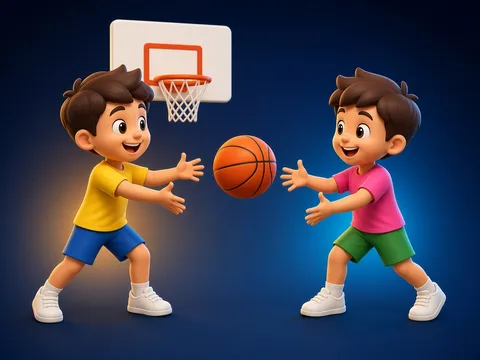
Hold the ball with both hands, fingers spread and thumbs behind it. The ball is in front of your chest with elbows down. Step forward with one foot and push the ball by straightening your arms; at the end your palms face outwards. The ball should fly straight to your partner’s chest. The catcher reaches forward, opens their fingers like a funnel and, on contact, draws the ball into the chest to soften it. Eyes always on the ball.
 What the book shows

In PE the child moves, plays and builds healthy habits. Every lesson starts with a warm-up and ends with calm exercises.
Textbook link:
This is not the textbook’s text but a short description of the topic. Check the exact page in your own textbook.
 The lesson step by step
- 1
Warm-up5 min
Ball warm-up.
- 2
New topic10 min
Passing technique.
- 3
Practice10 min
Catching.
- 4
Game10 min
Pair record.
- 5
Wrap-up5 min
Mini game.
 Let’s understand
For the student Simple language
| Passer | Catcher |
|---|---|
| 🤲 fingers spread, ball at chest | 🙌 arms forward, “funnel” |
| 👣 step forward | 👀 eyes on the ball |
| 💪 straighten arms, push | ↩️ draw the ball in |
| 🖐 palms out | 🤝 call “Got it!” |
 For the parent
How to help
- Pass a soft ball in the yard, taking one step back each time.
- Play “10 passes without a drop”.
 For the teacher
 Lesson goals
- Pass the ball with a two-handed chest pass, catch it with hands open like a funnel, and make a series of passes with a partner.
How to teach it
- Warm-up, active games, demonstration, pair and team work
 Differentiation
- Weaker pupils: easier version and shorter distance; stronger pupils: an extra challenge
 Questions for the class
- How do we pass accurately?
 How to check
The pupil performs the chest pass correctly and catches with funnel hands.
 Scientific Scientific language
Why draw the ball in?
Giving the ball more time to stop softens the impact, so your hands don’t hurt and it doesn’t bounce out.
The step adds power
Stepping forward puts your whole body’s strength into the pass.
Self-study
Step by step
- Fingers spread, ball at chest.
- Step and push.
- Funnel hands, eyes on the ball.
- Draw it in.
Going deeper
 Scientific language: for older students, parents and teachers.
In basketball and handball accurate passing wins points: good passing makes a good team.
 Play and check
Passer or catcher?
 How to write it down
- Draw the chest pass in 3 pictures.
- Record your pair’s best run of passes.
How the classwork looks in the notebook
Sample: the date and heading follow this country’s notebook rules.
 Watch out: common mistakes
 Where it helps in life
- Bounce pass
- Team games
 At home
Core
- Do 20 chest passes against a wall and catch them.
Extra ⭐
- Pass with a parent from 2, 3 and 4 metres: at what distance did you manage 10 without a drop?
How to do it
- Do the exercise in a safe place with a grown-up nearby.
- Then drink water and rest.
Answers for parents
Answers vary. The further apart you are, the stronger and more accurate the pass must be.
Step-by-step homework solution — Show the solution (try it yourself first)
Calculate
- 4 pairs, 10 passes each: 4 × 10 = 40 passes.
How the homework looks in the notebook
Sample: the date and heading follow this country’s notebook rules.

 About cookies