


Staying safe: strong passwords and kindness online


 About this lesson
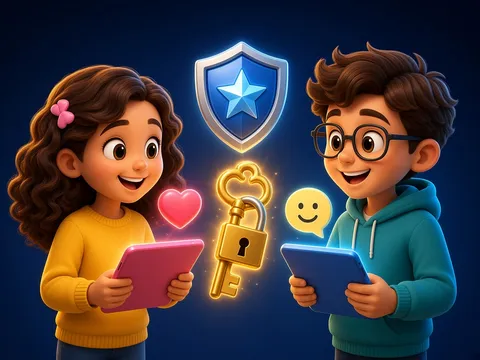
A strong password is long (at least 8 characters), mixes letters, numbers and symbols, and is hard to guess. A name, a birthday or “12345” is weak. Tell nobody your password except your parents. Online we are as polite as in real life: we greet, say thank you, don’t tease and don’t “shout” in capital letters. If someone is unkind, we don’t reply; we show an adult.
 What the book shows

In computer science the child first learns to think through unplugged games: recognising information, ordering steps and learning safety rules.
Textbook link:
This is not the textbook’s text but a short description of the topic. Check the exact page in your own textbook.
 The lesson step by step
- 1
Warm-up5 min
Key and padlock.
- 2
New topic10 min
Strong passwords and kindness.
- 3
Practice10 min
Good or bad.
- 4
Game10 min
“What would you write?” cards.
- 5
Wrap-up5 min
Kindness poster.
 Let’s understand
For the student Simple language
| Weak password ❌ | Strong password ✅ |
|---|---|
| 12345 | Long and mixed: letters + numbers + symbols |
| your name | A word mix only you know |
| your birthday | Never told to anyone |
| Being polite online |
|---|
| 👋 Say hello, 🙏 say thank you. |
| 🚫 Don’t tease anyone. |
| 🔠 Don’t “shout” in CAPITALS. |
| 🙋 If someone is unkind, show an adult. |
 For the parent
How to help
- Make up a “passphrase” together (for example three words + a number + a symbol), but never share it.
- Talk through “What would you write?” situations.
 For the teacher
 Lesson goals
- Know what makes a strong password and follow the rules of polite communication online.
How to teach it
- Unplugged games, cards, role play, discussion
 Differentiation
- Weaker pupils: 2–3 steps; stronger pupils build their own algorithm
 Questions for the class
- What makes a strong password and how are we polite online?
 How to check
The pupil tells strong from weak passwords and explains 3 kindness rules.
 Scientific Scientific language
Why long?
The longer and more mixed a password is, the more guesses it takes to crack.
The other side of the screen
A real person reads what we write online, and they have feelings too.
Self-study
Step by step
- Is my password long and mixed?
- Have I kept it secret?
- Before I post: is it polite?
- Hurt? Tell an adult.
Going deeper
 Scientific language: for older students, parents and teachers.
Some accounts ask for a code sent to a phone as well as the password; this is two-step protection.
 Play and check
Strong or weak? Polite or not?
 How to write it down
- Write and draw 4 online politeness rules.
- Write an example of a weak and a strong password (not your real one!).
How the classwork looks in the notebook
Sample: the date and heading follow this country’s notebook rules.
 Watch out: common mistakes
 Where it helps in life
- Protecting personal data
- Spotting fake news
 At home
Core
- Make an “Online kindness” poster with your family.
Extra ⭐
- Write 3 situations and the right thing to do in each.
How to do it
- Do the task with a grown-up.
- Explain in words what you noticed.
Answers for parents
For example: someone in a game writes “you’re rubbish” → I don’t reply and I show a parent. A friend shares a drawing → I write “That’s lovely!”
Step-by-step homework solution — Show the solution (try it yourself first)
Choose
- “kitty2015” is weak (a simple word and a year). A long mix of words, numbers and symbols is stronger.
How the homework looks in the notebook
Sample: the date and heading follow this country’s notebook rules.

 About cookies