


Daily routine


 About this lesson
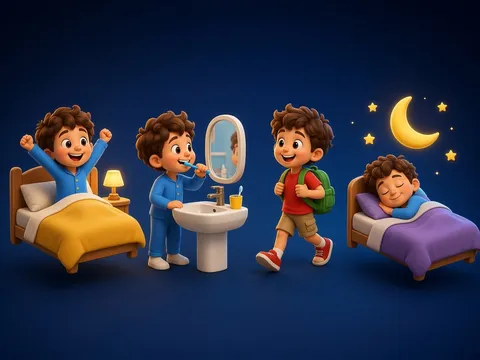
Daily activities: get up, wash my face, brush my teeth, have breakfast, go to school, do my homework, go to bed. Sentences start with “I”: I get up. I go to school.
 What the book shows

In Year 3 topics are learned through short sentences and questions and answers: we listen to the words, repeat a sentence pattern and build pair dialogues.
Textbook link:
This is not the textbook’s text but a short description of the topic. Check the exact page in your own textbook.
 The lesson step by step
- 1
Warm-up5 min
Song: “This is the way…”
- 2
New topic10 min
Routines and “I…”.
- 3
Practice10 min
Morning and evening.
- 4
Game10 min
Mime it, your partner guesses.
- 5
Wrap-up5 min
My day.
 Let’s understand
For the student Simple language
| Sentence | Action |
|---|---|
| I get up. | 🛏️ out of bed |
| I brush my teeth. | 🪥 |
| I have breakfast. | 🍳 |
| I go to school. | 🎒 |
| I do my homework. | 📒 |
| I go to bed. | 🌙 |
 For the parent
How to help
- In the morning say each action together in English: “I get up!”
- In the evening ask: What do you do in the morning?
 For the teacher
 Lesson goals
- Name daily activities in English and say 3 sentences about your day with “I get up…”.
How to teach it
- Listening, picture cards, pair dialogues, songs and action games
 Differentiation
- Weaker pupils: words and a ready pattern; stronger pupils: a 3-sentence talk
 Questions for the class
- Tell about your day in 3–4 English sentences.
 How to check
The pupil says 4 sentences in the correct word order.
 Scientific Scientific language
Word order
An English sentence puts who (I) first and then the action (get up): I get up.
Sequence words
first, then and after that help you tell your day in order.
Self-study
Step by step
- Who? I.
- What do I do? get up, go…
- Order: first, then.
- Say it aloud.
Going deeper
 Scientific language: for older students, parents and teachers.
With “he” and “she” we add -s: She gets up. He goes to school.
 Play and check
Morning or evening?
 How to write it down
- Draw 4 pictures titled “My day” and write a sentence under each: I get up. I…
How the classwork looks in the notebook
Sample: the date and heading follow this country’s notebook rules.
 Watch out: common mistakes
 Where it helps in life
- What time is it?
- Days of the week
 At home
Core
- Write 4 sentences about your morning using first and then.
Extra ⭐
- Tell 3 sentences about a family member’s day: He gets up…
How to do it
- Say the sentences aloud.
- Play question and answer with a grown-up.
Answers for parents
For example: First I get up. Then I wash my face. Then I have breakfast. After that I go to school. With “he” the action gets an -s: He gets up.
Step-by-step homework solution — Show the solution (try it yourself first)
Tell
- First I get up. Then I brush my teeth. Then I go to school.
How the homework looks in the notebook
Sample: the date and heading follow this country’s notebook rules.

 About cookies