


Calm and cheerful music: tempo and character


 About this lesson
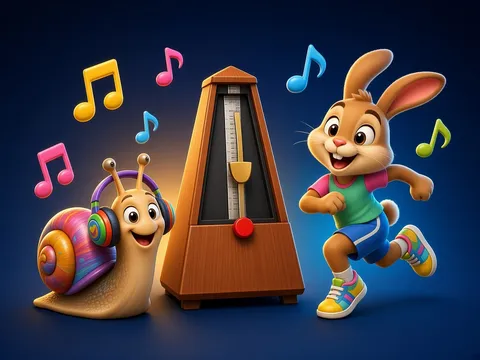
Tempo is the speed of music. A fast tempo makes music cheerful, energetic or even exciting (a running rabbit 🐇). A slow tempo makes it calm, singing or sometimes sad (a crawling snail 🐌). A medium tempo is like walking speed. A metronome shows the tempo with an even tick. The same song played at a different tempo changes its character.
 What the book shows

In music lessons the child listens, sings, claps and moves. The textbook pictures and songs are a starting point for listening.
Textbook link:
This is not the textbook’s text but a short description of the topic. Check the exact page in your own textbook.
 The lesson step by step
- 1
Warm-up5 min
Steps to a metronome.
- 2
New topic10 min
Tempo and character.
- 3
Practice10 min
Find the tempo.
- 4
Game10 min
“Rabbit and snail” game.
- 5
Wrap-up5 min
One song, two tempos.
 Let’s understand
For the student Simple language
| Tempo | Feels | Movement |
|---|---|---|
| 🐇 fast | cheerful, lively | running, skipping |
| 🚶 medium | steady | walking |
| 🐌 slow | calm, singing | gentle swaying |
 For the parent
How to help
- Sing a song slowly then fast and talk about the difference.
- Walk in time with a metronome app.
 For the teacher
 Lesson goals
- Identify tempo by ear (fast, medium, slow) and explain how tempo changes the music’s character.
How to teach it
- Listening, singing, clapping, moving to music
 Differentiation
- Weaker pupils: simple rhythm and movement; stronger pupils make their own rhythm
 Questions for the class
- What is tempo and how does it change the character?
 How to check
The pupil names the tempo and mood of 3 pieces.
 Scientific Scientific language
Body and tempo
Many people relax to calm music while fast music makes us want to move, which is why we pick fast music for sport and slow music before bed.
The metronome
A metronome shows tempo exactly; musicians practise with it.
Self-study
Step by step
- Listen: fast, medium or slow?
- How does it feel?
- Move to match.
Going deeper
 Scientific language: for older students, parents and teachers.
In some pieces the tempo gradually speeds up or slows down, building excitement or calm.
 Play and check
Which tempo fits?
 How to write it down
- Draw three animals for three tempos and write the mood beside each.
How the classwork looks in the notebook
Sample: the date and heading follow this country’s notebook rules.
 Watch out: common mistakes
 Where it helps in life
- Musical means of expression
- Composers’ works
 At home
Core
- Listen to 3 pieces and write their tempo and mood.
Extra ⭐
- Sing a favourite song at two tempos and write how it changes.
How to do it
- Listen or sing with a grown-up.
- Say in words what you felt.
Answers for parents
For example: a march is medium and brisk; a lullaby is slow and calm; a dance is fast and cheerful. A song sounds happier fast and calmer slow.
Step-by-step homework solution — Show the solution (try it yourself first)
Think
- Sung very slowly, a birthday song can sound sad rather than happy: tempo changes character.
How the homework looks in the notebook
Sample: the date and heading follow this country’s notebook rules.

 About cookies