


Multiplying by 4, 5 and 6


 About this lesson
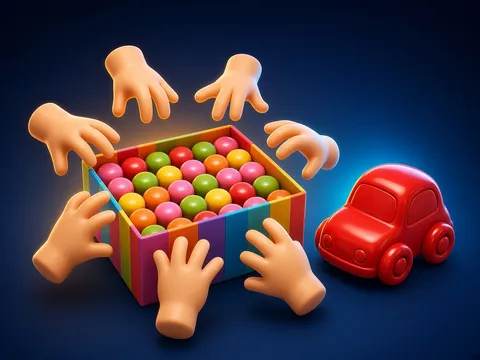
Multiplication is a short way to add equal numbers: 4 + 4 + 4 = 3 × 4 = 12. Handy tricks: to multiply by 4, double twice: 4 × 7 = 2 × (2 × 7) = 28. Answers in the 5 times table always end in 0 or 5: 5 × 6 = 30. To multiply by 6, multiply by 5 and add one more group: 6 × 7 = 5 × 7 + 7 = 42. Swapping the factors doesn’t change the product: 4 × 6 = 6 × 4 = 24; turn an array round and the rows become columns.
 What the book shows

The textbook usually gives a picture example, a short rule and a few sums and word problems. Show the example with objects first, then solve in the notebook.
Textbook link:
This is not the textbook’s text but a short description of the topic. Check the exact page in your own textbook.
 The lesson step by step
- 1
Warm-up5 min
Fingers and wheels.
- 2
New topic10 min
Arrays.
- 3
Practice10 min
Tricks.
- 4
Game10 min
Times-table race.
- 5
Wrap-up5 min
Making problems.
 Let’s understand
For the student Simple language
| × | 4 | 5 | 6 |
|---|---|---|---|
| 1 | 4 | 5 | 6 |
| 2 | 8 | 10 | 12 |
| 3 | 12 | 15 | 18 |
| 4 | 16 | 20 | 24 |
| 5 | 20 | 25 | 30 |
| 6 | 24 | 30 | 36 |
| 7 | 28 | 35 | 42 |
| 8 | 32 | 40 | 48 |
| 9 | 36 | 45 | 54 |
| 10 | 40 | 50 | 60 |
 For the parent
How to help
- Count in fives with fingers and in fours with car wheels.
- Show multiplication with an egg box (2 rows of 6).
 For the teacher
 Lesson goals
- Know the 4, 5 and 6 times tables, explain them with arrays and equal groups, and use the fact that the order of factors doesn’t matter.
How to teach it
- Modelling with objects, number lines, pair problem-solving, independent work
 Differentiation
- Weaker pupils: with objects and pictures; stronger pupils: write their own problem
 Questions for the class
- How can we remember the 4, 5 and 6 tables easily?
 How to check
The pupil knows the tables, explains the tricks and solves problems.
 Scientific Scientific language
Fives on the clock
Each number on a clock face is 5 minutes: at 3 it’s 15, at 6 it’s 30.
Even answers
Every answer in the 4 and 6 times tables is even.
Self-study
Step by step
- How many groups, and how many in each?
- Pick a trick: double twice, or 5 groups plus one.
- Check by swapping the factors.
Going deeper
 Scientific language: for older students, parents and teachers.
Each cell in a honeycomb has 6 sides; groups of six appear in nature too.
 Play and check
Which product?
 How to write it down
- Write out the 4, 5 and 6 times tables.
- Show 6 × 8 by drawing an array.
How the classwork looks in the notebook
Sample: the date and heading follow this country’s notebook rules.
 Watch out: common mistakes
 Where it helps in life
- Multiplying by 7, 8 and 9
- Division
 At home
Core
- Practise the tables for 5 minutes a day.
Extra ⭐
- Make up and solve 3 word problems with 4, 5 and 6.
How to do it
- Solve the sums in your notebook.
- Check the answer with the inverse operation.
Answers for parents
For example: Each car has 4 wheels. How many wheels do 8 cars have? 8 × 4 = 32. A box has 6 rows of 5 sweets: 6 × 5 = 30.
Step-by-step homework solution — Show the solution (try it yourself first)
Problem
- A classroom has 6 rows with 4 desks in each: 6 × 4 = 24 desks.
How the homework looks in the notebook
Sample: the date and heading follow this country’s notebook rules.

 About cookies