


Perimeter


 About this lesson
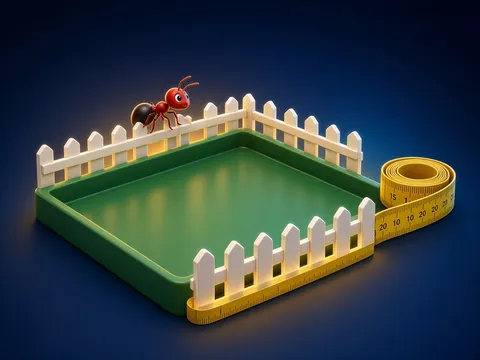
Perimeter is the length of the path around a shape. It tells us how much fencing goes round a garden.
 What the book shows

In the textbook perimeter is usually introduced with real situations: a fence, a frame, an ant’s path. Then shapes are measured on squared paper and the sides added.
Textbook link:
This is not the textbook’s text but a short description of the topic. Check the exact page in your own textbook.
 The lesson step by step
- 1
The ant’s path5 min
We trace round the shape.
On the board3 + 3 + 3 + 3 - 2
Measuring with string10 min
We lay string round the shape and measure it.
On the boardP = 12 cm - 3
Formula10 min
The short way for a rectangle.
On the boardP = 2 × (a + b) - 4
In the notebook10 min
We draw a shape and find its perimeter.
In the notebookP = 4 + 2 + 4 + 2 - 5
Wrap-up5 min
What is perimeter? In one sentence.
 Let’s understand
For the student Simple language
An ant walked once round the edge of a square card. Each side was 3 cm. How far did the ant walk? 3 + 3 + 3 + 3 = 12 cm. That is the square’s perimeter.
 For the parent
How to help
- Measure the sides of a book with a ruler and add them.
- “Measure” the room in steps along the walls.
- Ask: why can we multiply one side of a square by 4?
What to check
- Counts every side and misses none.
- Writes the unit in the answer (cm).
 For the teacher
 Lesson goals
- Present perimeter as the sum of the sides.
- Find the shortcut for rectangles and squares.
How to teach it
- String, ruler, squared paper.
 Differentiation
- For those who struggle: colour and count the sides.
- For fast finishers: shapes with the same perimeter.
 Questions for the class
- How is perimeter different from area?
 How to check
The pupil solves 4 of 5 correctly, with units.
 Scientific Scientific language
The core idea
The perimeter of a polygon is the sum of its side lengths: P = a + b + c + …. For a rectangle P = 2 × (a + b), for a square P = 4 × a. It is measured in units of length (cm, m).
Techniques
- Measure round a shape with string.
- Draw shapes on squared paper.
- Build different shapes with the same perimeter.
Self-study
Step-by-step plan
- Count the sides.
- Write each length.
- Add them and write the unit.
Going deeper
 Scientific language: for older students, parents and teachers.
The word perimeter comes from Greek: “peri” — around, “metron” — measure. Among rectangles with the same perimeter the square has the largest area — a simple case of the famous “isoperimetric” problem. Of all shapes with a given boundary length, the circle encloses the most area.
The perimeter of a circle is called its circumference; in later grades it is found using π.
 Play and check
Is the perimeter 12 cm or not?
 How to write it down
- On squared paper draw a 4 × 2 rectangle (take 1 square as 1 cm).
- Label the side lengths.
- Write: P = 4 + 2 + 4 + 2 = 12 cm.
How the classwork looks in the notebook
Sample: the date and heading follow this country’s notebook rules.
 Watch out: common mistakes
 Where it helps in life
- Fences and frames: how much material you need.
- Area comes next.
- Sport: one lap of a track is a perimeter.
 At home
Core
- Find the perimeter of a square with 5 cm sides.
- Find the perimeter of a 6 cm by 3 cm rectangle.
Challenge ⭐
- Draw two different rectangles with a perimeter of 16 cm.
How to do it
- A square has four equal sides: multiply one side by 4.
- For a rectangle add length and width, then multiply by 2.
- Challenge: half of 16 is 8 — length and width must make 8.
Answers for parents
20 cm. 18 cm. ⭐ For example 5 × 3, 6 × 2, 7 × 1 or 4 × 4.
Step-by-step homework solution — Show the solution (try it yourself first)
Square 5 cm
- 4 equal sides: 5 + 5 + 5 + 5 or 4 × 5.
- 20 cm.
Rectangle 6 by 3
- 6 + 3 + 6 + 3 or 2 × (6 + 3).
- 18 cm.
⭐ P = 16
- Length + width must make 8: 5 + 3, 6 + 2, 7 + 1, 4 + 4.
How the homework looks in the notebook
Sample: the date and heading follow this country’s notebook rules.

 About cookies