


Capacity: litres


 About this lesson
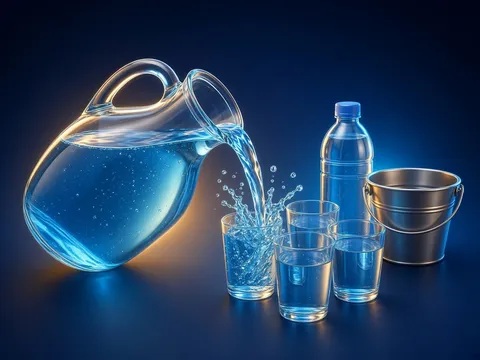
Capacity tells us how much liquid a container holds. The main unit is the litre (l). Very small amounts are measured in millilitres (ml): 1 l = 1000 ml. To measure capacity we use a measuring container: for example, we fill a bucket using a 1-litre jar and count how many times we pour. A tall thin container and a short wide one can hold the same amount; to check, we pour water from one into the other. Litres can be added and subtracted: 5 l + 3 l = 8 l.
 What the book shows

The textbook usually gives a picture example, a short rule and a few sums and word problems. Show the example with objects first, then solve in the notebook.
Textbook link:
This is not the textbook’s text but a short description of the topic. Check the exact page in your own textbook.
 The lesson step by step
- 1
Warm-up5 min
Which holds most?
- 2
New topic10 min
Litres and millilitres.
- 3
Practice10 min
Measuring by pouring.
- 4
Game10 min
Problems.
- 5
Wrap-up5 min
Saving water.
 Let’s understand
For the student Simple language
| Container | Rough capacity |
|---|---|
| teaspoon | about 5 ml |
| glass | about 200–250 ml |
| milk carton | often 1 l |
| bucket | often 10 l |
 For the parent
How to help
- Measure water together with a measuring jug in the kitchen.
- Read the litres on bottles and cartons.
 For the teacher
 Lesson goals
- Measure capacity in litres, compare capacities and solve adding and subtracting problems with litres.
How to teach it
- Modelling with objects, number lines, pair problem-solving, independent work
 Differentiation
- Weaker pupils: with objects and pictures; stronger pupils: write their own problem
 Questions for the class
- How do we measure capacity?
 How to check
The pupil measures in litres, chooses l or ml, compares and solves problems.
 Scientific Scientific language
Water and mass
1 litre of water has a mass of about 1 kilogram.
Saving water
Turning off the tap while brushing your teeth saves many litres.
Self-study
Step by step
- Which unit: l or ml?
- How many times did I pour?
- Shape doesn’t decide capacity: I check by pouring.
Going deeper
 Scientific language: for older students, parents and teachers.
The same water looks like more in a tall thin glass; our eyes can be fooled, so we check by pouring.
 Play and check
Which unit fits?
 How to write it down
- Write down the capacity printed on 4 containers.
- 4 l + 6 l, 10 l − 3 l, 2 l = … ml.
How the classwork looks in the notebook
Sample: the date and heading follow this country’s notebook rules.
 Watch out: common mistakes
 Where it helps in life
- Volume
- Converting units
 At home
Core
- Find out how many glasses fill a 1-litre bottle.
Extra ⭐
- Make up 2 word problems with litres.
How to do it
- Solve the sums in your notebook.
- Check the answer with the inverse operation.
Answers for parents
It depends on the glass: a 250 ml glass fills it in 4 pours (4 × 250 = 1000 ml).
Step-by-step homework solution — Show the solution (try it yourself first)
Problem
- 3 buckets of 10 l each are poured into a fish tank: 3 × 10 = 30 l.
How the homework looks in the notebook
Sample: the date and heading follow this country’s notebook rules.

 About cookies