


Tertiary colours: the 12-part colour wheel


 About this lesson
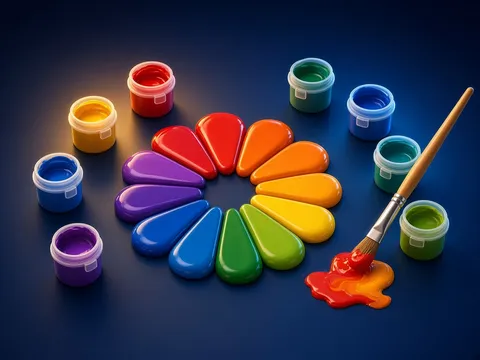
Last year we learned three primaries (red, yellow, blue) and three secondaries (orange, green, purple). Now we mix a neighbouring primary and secondary to get a tertiary colour: red + orange = red-orange, yellow + green = yellow-green, and so on. There are six of them. 3 primaries + 3 secondaries + 6 tertiaries = 12 colours: a 12-part wheel.
 What the book shows

In art lessons the child explores colour, line and shape, draws and creates patterns. Look at the textbook examples, then make your own work.
Textbook link:
This is not the textbook’s text but a short description of the topic. Check the exact page in your own textbook.
 The lesson step by step
- 1
Warm-up5 min
Colour riddle.
- 2
New topic10 min
Tertiary colours.
- 3
Practice10 min
Mixing.
- 4
Game10 min
The 12-part wheel.
- 5
Wrap-up5 min
Painting with neighbours.
 Let’s understand
For the student Simple language
| Primary | + Secondary | = Tertiary |
|---|---|---|
| 🔴 red | 🟠 orange | red-orange |
| 🟡 yellow | 🟠 orange | yellow-orange |
| 🟡 yellow | 🟢 green | yellow-green |
| 🔵 blue | 🟢 green | blue-green |
| 🔵 blue | 🟣 purple | blue-purple |
| 🔴 red | 🟣 purple | red-purple |
 For the parent
How to help
- Mix tertiary colours together on a plate.
- Find objects at home in tertiary colours (for example, a blue-green towel).
 For the teacher
 Lesson goals
- Mix a primary with a secondary colour to make tertiary colours and build a 12-part colour wheel.
How to teach it
- Observation, drawing, colour mixing, a class display
 Differentiation
- Weaker pupils colour a ready outline; stronger pupils create their own composition
 Questions for the class
- How do you make a tertiary colour?
 How to check
The pupil mixes the 6 tertiary colours and fills the 12-part wheel correctly.
 Scientific Scientific language
Proportion matters
A little orange in red gives a colour close to red; a lot gives one close to orange.
A wheel like a clock
The 12 colours sit like the 12 numbers on a clock face, each with two neighbours.
Self-study
Step by step
- Which two neighbours am I mixing?
- Start with the lighter colour and add the darker one bit by bit.
- Put the colour in its place on the wheel.
Going deeper
 Scientific language: for older students, parents and teachers.
Artists often use colours that sit side by side on the wheel, which makes a picture look calm and harmonious.
 Play and check
Which group is this colour in?
 How to write it down
- Divide a circle into 12 parts and fill the wheel.
- Under each tertiary colour write what it was mixed from.
How the classwork looks in the notebook
Sample: the date and heading follow this country’s notebook rules.
 Watch out: common mistakes
 Where it helps in life
- Complementary colours
- Mood through colour
 At home
Core
- Paint the 12-part wheel.
Extra ⭐
- Paint a small scene using only 3 neighbouring colours (for example yellow, yellow-green and green).
How to do it
- Prepare a quiet spot and materials.
- Show your work to a grown-up and explain it.
Answers for parents
Order on the wheel: yellow, yellow-orange, orange, red-orange, red, red-purple, purple, blue-purple, blue, blue-green, green, yellow-green.
Step-by-step homework solution — Show the solution (try it yourself first)
Mix
- You need blue-purple: blue + purple, with more blue.
How the homework looks in the notebook
Sample: the date and heading follow this country’s notebook rules.

 About cookies