


Natural zones


 About this lesson
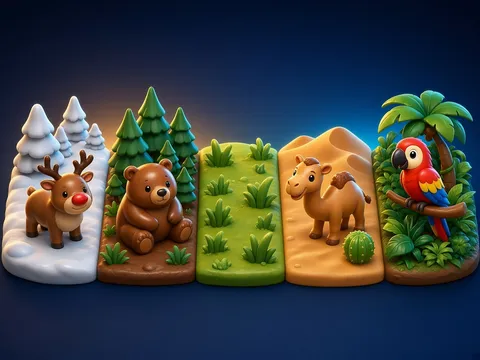
A natural zone is a large area with similar climate, soil, plants and animals. From the poles to the equator: tundra (cold, mosses, reindeer), forest zone (conifer and broadleaf forests, bears, squirrels), steppe (hot summers, grassland, rodents), desert (very dry, few plants, camels, lizards) and tropical rainforest (hot and rainy, huge variety of plants, parrots, monkeys). Zones change mainly with warmth and moisture. Azerbaijan has semi-desert and dry steppe (for example on the Kura-Aras lowland), mountain forests (in the Greater and Lesser Caucasus and the Talysh mountains) and meadows high in the mountains. Zones also change as you climb a mountain.
 What the book shows

The textbook usually gives a big picture, questions and a small observation or project task. Talk about the picture, link the questions to everyday life and carry on the observation at home.
Textbook link:
This is not the textbook’s text but a short description of the topic. Check the exact page in your own textbook.
 The lesson step by step
- 1
Warm-up5 min
A globe journey.
- 2
New topic10 min
The zones.
- 3
Practice10 min
Plants and animals.
- 4
Game10 min
Azerbaijan’s zones.
- 5
Wrap-up5 min
Mini-report.
 Let’s understand
For the student Simple language
| Zone | Climate | Plants | Animals |
|---|---|---|---|
| ❄️ tundra | cold | mosses | reindeer |
| 🌲 forest | mild | pine, oak | bear, squirrel |
| 🌾 steppe | hot summers | grasses | rodents |
| 🏜️ desert | very dry | thorny shrubs | camel |
| 🌴 rainforest | hot, rainy | many kinds | parrot |
 For the parent
How to help
- Find the natural zones on a map or globe and compare places you’ve visited.
 For the teacher
 Lesson goals
- Know Earth’s main natural zones with their climate, plants and animals, and name the zones found in Azerbaijan.
How to teach it
- Observation, picture talk, group work, mini-project
 Differentiation
- Weaker pupils: with pictures and cards; stronger pupils: find an extra fact and tell the class
 Questions for the class
- Why are natural zones different?
 How to check
The pupil names 5 zones and their features.
 Scientific Scientific language
Why do zones change?
Places near the equator get more heat from the Sun.
Zones on mountains
It gets colder as you climb, so there can be forest at the foot, meadows higher up and snow at the top.
Self-study
Step by step
- I named 5 zones.
- I said each zone’s climate.
- I gave plant and animal examples.
- I know Azerbaijan’s zones.
Going deeper
 Scientific language: for older students, parents and teachers.
Plants and animals are adapted to their zone: a camel’s hump and a reindeer’s thick coat are examples.
 Play and check
Which zone does it live in?
 How to write it down
- Write the 5 zones in a table.
- Draw one zone.
How the classwork looks in the notebook
Sample: the date and heading follow this country’s notebook rules.
 Watch out: common mistakes
 Where it helps in life
- Natural resources
- Protecting nature
 At home
Core
- Choose a natural zone and prepare a 5-sentence mini-report.
Extra ⭐
- Find out and write which natural zone of Azerbaijan you live in.
How to do it
- Observe at home or talk with an adult.
- Write or draw what you found.
Answers for parents
Example (desert): It rains very little. Days are very hot and nights cool. Plants have long roots. Camels can go a long time without drinking. People live at oases.
Step-by-step homework solution — Show the solution (try it yourself first)
Think
- At the foot of a mountain it is 15 °C, and it gets about 6 °C colder for every 1 km up. At 2 km it is about 15 − 12 = 3 °C.
How the homework looks in the notebook
Sample: the date and heading follow this country’s notebook rules.

 About cookies