


Historic monuments of Azerbaijan


 About this lesson
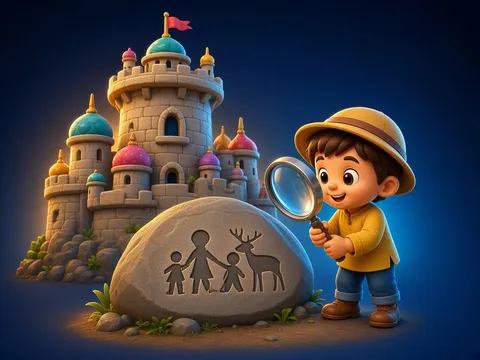
Historic monuments are a legacy of the past: they show a people’s history, art and life. Baku’s old town Icherisheher, with the Maiden Tower and the Palace of the Shirvanshahs, was added to UNESCO’s World Heritage List in 2000. The Gobustan rock art (pictures of people, animals and boats carved into stone by ancient people) was added in 2007. The historic centre of Shaki with the Khan’s Palace, famous for its coloured-glass shabaka windows, was added in 2019. In Nakhchivan stands the Momine Khatun Mausoleum, built in the 12th century by the architect Ajami Nakhchivani. Never write on monuments or take their stones: they belong to every generation.
 What the book shows

The textbook usually gives a big picture, questions and a small observation or project task. Talk about the picture, link the questions to everyday life and carry on the observation at home.
Textbook link:
This is not the textbook’s text but a short description of the topic. Check the exact page in your own textbook.
 The lesson step by step
- 1
Warm-up5 min
Picture riddle.
- 2
New topic10 min
Baku’s monuments.
- 3
Practice10 min
Gobustan and Shaki.
- 4
Game10 min
Nakhchivan.
- 5
Wrap-up5 min
Protecting monuments.
 Let’s understand
For the student Simple language
| Monument | Where? | Famous for |
|---|---|---|
| 🏰 Maiden Tower | Baku, Old City | an ancient round tower |
| 🕌 Palace of the Shirvanshahs | Baku, Old City | a medieval palace complex |
| 🪨 Gobustan | near Baku | rock carvings |
| 🪟 Khan’s Palace | Shaki | shabaka glass windows |
| 🏛️ Momine Khatun Mausoleum | Nakhchivan | 12th century, architect Ajami |
 For the parent
How to help
- Visit a nearby monument or museum together, reading about it first.
 For the teacher
 Lesson goals
- Recognise Azerbaijan’s famous historic monuments, know where they are and understand why we protect them.
How to teach it
- Observation, picture talk, group work, mini-project
 Differentiation
- Weaker pupils: with pictures and cards; stronger pupils: find an extra fact and tell the class
 Questions for the class
- What do historic monuments tell us?
 How to check
The pupil names 4 monuments with their locations and says how to protect them.
 Scientific Scientific language
Shabaka
Shabaka windows are assembled from interlocking wooden pieces without nails or glue.
UNESCO
UNESCO lists monuments valuable to all humanity and helps protect them.
Self-study
Step by step
- I named 4 monuments.
- I said where they are.
- I know how to protect monuments.
Going deeper
 Scientific language: for older students, parents and teachers.
Every monument is like a history book: its stones, patterns and inscriptions tell us about the past.
 Play and check
Where is it?
 How to write it down
- Draw a monument and write 3 sentences.
- Write 3 rules for protecting monuments.
How the classwork looks in the notebook
Sample: the date and heading follow this country’s notebook rules.
 Watch out: common mistakes
 Where it helps in life
- Notable people
- Learning our history
 At home
Core
- Find out about a historic monument where you live: its name, place and what it’s famous for.
Extra ⭐
- Make a small guide card for it (picture and 4 sentences).
How to do it
- Observe at home or talk with an adult.
- Write or draw what you found.
Answers for parents
The card should have the name, location, roughly when it was built (write “ancient” or “medieval” if unsure), what is interesting and how to protect it.
Step-by-step homework solution — Show the solution (try it yourself first)
Think
- Icherisheher joined the UNESCO list in 2000. By 2026, 2026 − 2000 = 26 years have passed.
How the homework looks in the notebook
Sample: the date and heading follow this country’s notebook rules.

 About cookies