


Emergencies


 About this lesson
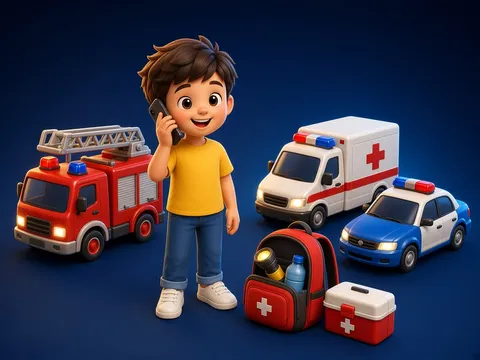
An emergency is a sudden event that puts lives in danger: an earthquake, fire, flood or strong wind. The main rule is to stay calm and follow adults’ instructions. In an earthquake: “Drop, cover, hold on”: get under a sturdy table, protect your head and hold the table leg; stay away from windows and cupboards; don’t use the lift. In a fire: smoke rises, so leave crouching low with a damp cloth over your mouth; don’t take the lift; call 101. In a flood: go to higher ground and never walk into flowing water. The single emergency number is 112; fire 101, police 102, ambulance 103. On the phone, calmly give your name, address and what happened. It helps to keep an emergency bag at home: water, a torch, a first-aid kit, copies of documents and warm clothes.
 What the book shows

The textbook usually gives a big picture, questions and a small observation or project task. Talk about the picture, link the questions to everyday life and carry on the observation at home.
Textbook link:
This is not the textbook’s text but a short description of the topic. Check the exact page in your own textbook.
 The lesson step by step
- 1
Warm-up5 min
What could happen?
- 2
New topic10 min
Earthquake.
- 3
Practice10 min
Fire and flood.
- 4
Game10 min
Call practice.
- 5
Wrap-up5 min
Emergency bag.
 Let’s understand
For the student Simple language
| Event | What we do |
|---|---|
| 🌍 earthquake | drop, cover, hold on · no lift |
| 🔥 fire | leave crouching low · damp cloth over mouth · 101 |
| 🌊 flood | go higher · never enter flowing water |
| ☎️ calling | 112 · name, address, what happened |
 For the parent
How to help
- Make a family evacuation plan: how we leave and where we meet.
- Pack an emergency bag together.
 For the teacher
 Lesson goals
- Know how to act safely in an earthquake, fire or flood, the emergency numbers (112, 101, 102, 103) and what goes in an emergency bag.
How to teach it
- Observation, picture talk, group work, mini-project
 Differentiation
- Weaker pupils: with pictures and cards; stronger pupils: find an extra fact and tell the class
 Questions for the class
- How do we keep safe in an emergency?
 How to check
The pupil gives the numbers and the rules for three situations.
 Scientific Scientific language
Why crouch?
Hot smoke rises, so the air near the floor is cleaner.
Why no lift?
In a quake or fire the power may cut and the lift can get stuck.
Self-study
Step by step
- I know 112, 101, 102 and 103.
- Earthquake: drop, cover, hold on.
- Fire: leave crouching low.
- I stay calm.
Going deeper
 Scientific language: for older students, parents and teachers.
Practice saves lives: evacuation drills help people act calmly and quickly in real danger.
 Play and check
Safe or dangerous?
 How to write it down
- Draw your home’s evacuation plan: the way out and meeting place.
- List what goes in an emergency bag.
How the classwork looks in the notebook
Sample: the date and heading follow this country’s notebook rules.
 Watch out: common mistakes
 Where it helps in life
- First aid
- Road safety
 At home
Core
- Practise the evacuation plan with your family.
Extra ⭐
- Write and practise a call script: “My name is…, address…, what happened…”.
How to do it
- Observe at home or talk with an adult.
- Write or draw what you found.
Answers for parents
Example call: “Hello, my name is Aysel, I’m 10. The address is … street, house …, flat …. There’s smoke in the kitchen. My granny and I are at home.” Then stay on the line and answer the operator’s questions.
Step-by-step homework solution — Show the solution (try it yourself first)
Think
- The school alarm goes off. Without grabbing bags or running, we follow the teacher in a line to the meeting point and get counted.
How the homework looks in the notebook
Sample: the date and heading follow this country’s notebook rules.

 About cookies