


Music groups: choir, ensemble, orchestra


 About this lesson
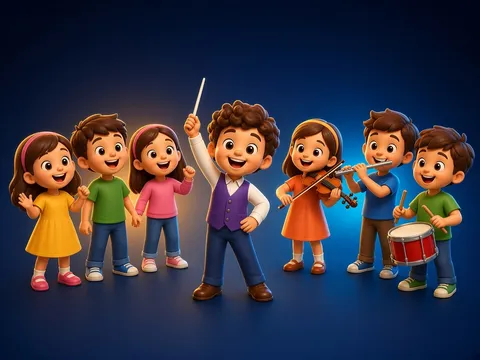
When musicians perform together they form a group. A choir is a group of singers singing together: children’s, men’s or women’s choirs. An ensemble is a small group: 2 players are a duet, 3 a trio, 4 a quartet. An orchestra is a large group of instrument players. A symphony orchestra has string, wind and percussion sections. A folk instrument orchestra plays national instruments such as the tar, kamancha, balaban and naghara drum. A conductor leads a large group, showing the speed and loudness with hands or a baton and helping everyone start and finish together.
 What the book shows

In music lessons the child listens, sings, claps and moves. The textbook pictures and songs are a starting point for listening.
Textbook link:
This is not the textbook’s text but a short description of the topic. Check the exact page in your own textbook.
 The lesson step by step
- 1
Warm-up5 min
Who sings, who plays?
- 2
New topic10 min
Choir and ensemble.
- 3
Practice10 min
Orchestra sections.
- 4
Game10 min
Conductor game.
- 5
Wrap-up5 min
Class choir.
 Let’s understand
For the student Simple language
| Group | Who? | How many? |
|---|---|---|
| 🎤 choir | singers | many |
| 🎻 duet / trio / quartet | players | 2 / 3 / 4 |
| 🎼 orchestra | strings, wind, percussion | dozens |
| 🪕 folk orchestra | tar, kamancha, balaban, naghara | dozens |
 For the parent
How to help
- Find an orchestra concert on TV or online and watch the conductor.
- Form a “family ensemble”: who sings and who claps?
 For the teacher
 Lesson goals
- Tell a choir, an ensemble and an orchestra apart, explain the conductor’s job, and recognise the instrument groups of a symphony and a folk orchestra.
How to teach it
- Listening, singing, clapping, moving to music
 Differentiation
- Weaker pupils: simple rhythm and movement; stronger pupils make their own rhythm
 Questions for the class
- How do musicians perform together?
 How to check
The pupil tells the groups apart and explains the conductor’s role.
 Scientific Scientific language
Why does the conductor face away from the audience?
They must see every musician, and the musicians must see them.
Choir voices
High and low voices sing different parts, making a rich harmony together.
Self-study
Step by step
- Singing or playing?
- How many people?
- Which instrument groups?
- What does the conductor show?
Going deeper
 Scientific language: for older students, parents and teachers.
Each player has only their own part, but the conductor has the full score with every instrument.
 Play and check
Which group is it?
 How to write it down
- Draw a plan of a symphony orchestra: strings, wind, percussion and the conductor.
- Explain duet, trio and quartet.
How the classwork looks in the notebook
Sample: the date and heading follow this country’s notebook rules.
 Watch out: common mistakes
 Where it helps in life
- Echo and canon
- Music on stage
 At home
Core
- Listen to an orchestral piece and write which instrument groups you hear.
Extra ⭐
- Sing a song as a duet with a friend.
How to do it
- Listen or sing with a grown-up.
- Say in words what you felt.
Answers for parents
Answers will vary. In a symphony orchestra you often hear violins (strings), flute and trumpet (wind) and drums (percussion).
Step-by-step homework solution — Show the solution (try it yourself first)
Think
- The conductor raises a hand and drops it: everyone starts together. Lowering it slowly makes the music quieter.
How the homework looks in the notebook
Sample: the date and heading follow this country’s notebook rules.

 About cookies