


Nature pictures in music


 About this lesson
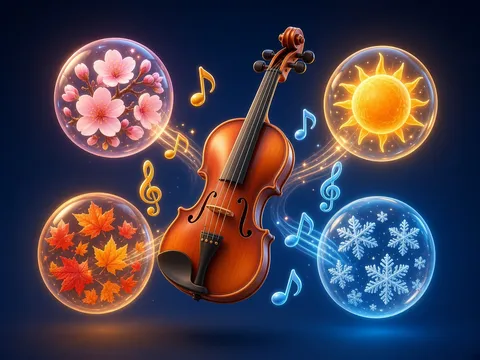
Some pieces have titles that tell listeners what to imagine: this is program music. Composers “paint” nature with sound: quick, light notes for birdsong, loud drums for thunder, a slow flowing tune for a calm river. Antonio Vivaldi’s “The Four Seasons” is four violin concertos: “Spring”, “Summer”, “Autumn” and “Winter”. Pyotr Tchaikovsky’s “The Seasons” has one piano piece for each month: 12 pieces. In Camille Saint-Saëns’s “The Carnival of the Animals”, music portrays a lion, an elephant, a swan and more.
 What the book shows

In music lessons the child listens, sings, claps and moves. The textbook pictures and songs are a starting point for listening.
Textbook link:
This is not the textbook’s text but a short description of the topic. Check the exact page in your own textbook.
 The lesson step by step
- 1
Warm-up5 min
Sounds of nature.
- 2
New topic10 min
Program music.
- 3
Practice10 min
Vivaldi and Tchaikovsky.
- 4
Game10 min
Listen and draw.
- 5
Wrap-up5 min
Class rainstorm.
 Let’s understand
For the student Simple language
| Nature | How the music shows it |
|---|---|
| 🐦 birds | high, fast, light notes |
| ⛈️ a storm | loud, drums, low sounds |
| 🌊 a calm river | a slow, flowing tune |
| ❄️ winter | cold, sharp, shivering sounds |
 For the parent
How to help
- Listen to Vivaldi’s “Spring” together and find the birdsong.
- On a walk, listen to and name the sounds of nature.
 For the teacher
 Lesson goals
- Know what program music is, and hear and describe how composers paint nature with tempo, tone colour and loudness.
How to teach it
- Listening, singing, clapping, moving to music
 Differentiation
- Weaker pupils: simple rhythm and movement; stronger pupils make their own rhythm
 Questions for the class
- How do composers “paint” nature with sound?
 How to check
The pupil explains program music and names the musical means used.
 Scientific Scientific language
Tone colour
A flute suits a bird, a cello a swan, a double bass an elephant, because their sounds have different “colours”.
Dynamics
Music getting gradually louder sounds like an approaching storm.
Self-study
Step by step
- What does the title suggest?
- Is the tempo fast or slow?
- Which instrument do I hear?
- Does it get louder or softer?
Going deeper
 Scientific language: for older students, parents and teachers.
In Vivaldi’s “Spring” the violins imitate birdsong so well that listeners almost “see” the birds.
 Play and check
Which nature scene fits the music?
 How to write it down
- Listen to a nature piece and draw it.
- Write its tempo, instruments and dynamics.
How the classwork looks in the notebook
Sample: the date and heading follow this country’s notebook rules.
 Watch out: common mistakes
 Where it helps in life
- Portraits in music
- Film music
 At home
Core
- Listen to the piece for your birthday month from Tchaikovsky’s “The Seasons”.
Extra ⭐
- Make a “rain” sound with things at home.
How to do it
- Listen or sing with a grown-up.
- Say in words what you felt.
Answers for parents
Answers vary. For rain: tap the table slowly, then faster; shake a jar of rice.
Step-by-step homework solution — Show the solution (try it yourself first)
Think
- The music starts quietly, grows louder, adds drums, then calms down again: like a storm arriving and passing.
How the homework looks in the notebook
Sample: the date and heading follow this country’s notebook rules.

 About cookies