


Area


 About this lesson
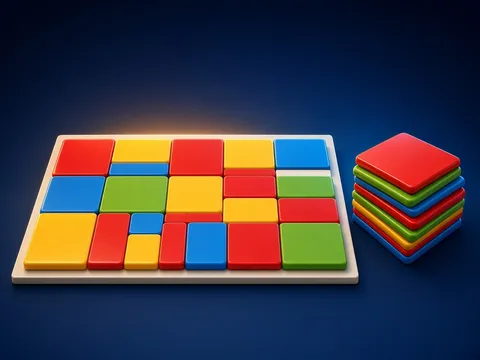
Area shows how much space a shape covers. We measure it with small 1 cm × 1 cm squares. In a rectangle, instead of counting them one by one, we multiply length by width.
 What the book shows

In the textbook area usually starts with shapes on a grid: first count the squares, then multiply rows by columns. Then the square centimetre is introduced.
Textbook link:
This is not the textbook’s text but a short description of the topic. Check the exact page in your own textbook.
 The lesson step by step
- 1
Tiles5 min
How many tiles for the floor?
On the board3 × 5 = 15 - 2
Counting squares10 min
Rows and columns.
- 3
Formula10 min
A = length × width.
On the boardS = a × b - 4
Perimeter and area10 min
We find both for one shape.
On the boardP = 16 · S = 15 - 5
Wrap-up5 min
We say the difference in one sentence.
 Let’s understand
For the student Simple language
We are tiling a floor. Each row has 5 tiles and there are 3 rows. How many tiles? 3 × 5 = 15. The floor’s area is 15 tiles!
 For the parent
How to help
- Measure a book cover with a ruler and estimate how many 1 cm squares fit.
- Ask: to choose a rug for the floor, do you need perimeter or area?
- Check that the child writes “cm²”.
What to check
- Multiplies length by width.
- Does not mix up area and perimeter.
 For the teacher
 Lesson goals
- The idea and units of area.
- The rectangle area formula.
How to teach it
- Squared paper, the tile model.
 Differentiation
- For those who struggle: count squares.
- For fast finishers: compound L-shapes.
 Questions for the class
- Why is area measured in square units?
 How to check
The pupil solves 4 of 5 correctly, with units.
 Scientific Scientific language
The core idea
Area measures a flat shape. A rectangle’s area is A = a × b. Area units are square: 1 cm² is the area of a square with 1 cm sides; 1 m² = 10,000 cm².
Techniques
- Count squares first, then rows × columns.
- Different shapes with the same area.
- Compare perimeter and area.
Self-study
Step-by-step plan
- Measure length and width.
- Multiply them.
- Write the answer in square units.
Going deeper
 Scientific language: for older students, parents and teachers.
Measuring area is one of the oldest mathematical skills: in ancient Egypt fields were re-measured after the Nile floods, and the Greek word “geometry” means “land measuring”. Area is additive: split a shape into parts and add their areas.
1 m² = 100 cm × 100 cm = 10,000 cm²; 1 hectare = 10,000 m².
 Play and check
Is the area 12 cm² or not?
 How to write it down
- Draw a 5 × 3 rectangle.
- Colour one row and count the squares.
- Write: A = 5 × 3 = 15 cm².
How the classwork looks in the notebook
Sample: the date and heading follow this country’s notebook rules.
 Watch out: common mistakes
 Where it helps in life
- DIY: paint, tiles and flooring are bought by area.
- Flat adverts give area in square metres.
- Geometry: the area of triangles and circles.
 At home
Core
- Find the area of a 7 cm × 4 cm rectangle.
- Find the area of a square with 6 cm sides.
Challenge ⭐
- Find all rectangles with an area of 24 cm² (whole-number sides).
How to do it
- Multiply length by width and write “cm²”.
- For a square multiply the side by itself.
- Challenge: look for 24 in the times tables.
Answers for parents
28 cm². 36 cm². ⭐ 1 × 24, 2 × 12, 3 × 8, 4 × 6.
Step-by-step homework solution — Show the solution (try it yourself first)
7 × 4
- Multiply: 7 × 4 = 28.
- 28 cm².
Square 6
- 6 × 6 = 36.
- 36 cm².
⭐ 24 cm²
- Find pairs that multiply to 24: 1 × 24, 2 × 12, 3 × 8, 4 × 6.
How the homework looks in the notebook
Sample: the date and heading follow this country’s notebook rules.

 About cookies