


Project: a bird feeder


 About this lesson
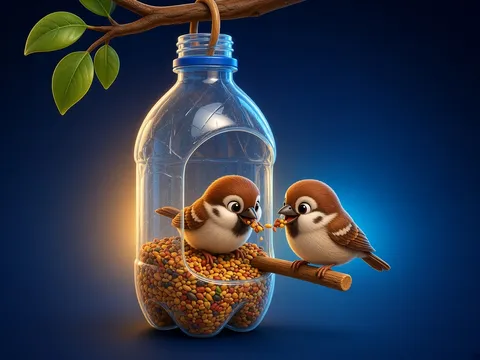
A project is planned work to solve a problem. The problem: in winter birds struggle to find food. Stages: 1) idea: what will we make? 2) plan: materials, tools, a sketch and the order of work; 3) making it; 4) presenting and testing. A clean plastic bottle, a milk carton, a wooden stick and string all work, giving rubbish a second life. An adult cuts the holes in the bottle; children measure, decorate and assemble. Put unsalted seeds, grains or breadcrumbs in the feeder; salty or fried food harms birds. Hang the feeder where cats can’t reach it.
 What the book shows

In technology lessons the child works with their hands: cutting, folding, gluing and making things from natural materials. Every task starts with a safety rule.
Textbook link:
This is not the textbook’s text but a short description of the topic. Check the exact page in your own textbook.
 The lesson step by step
- 1
Warm-up5 min
Birds in winter.
- 2
New topic10 min
Project stages.
- 3
Practice10 min
Plan and sketch.
- 4
Game10 min
Building the feeder.
- 5
Wrap-up5 min
Presenting.
 Let’s understand
For the student Simple language
| Stage | What we do |
|---|---|
| 💡 idea | help birds in winter |
| 📝 plan | materials, tools, sketch |
| 🛠️ making | an adult cuts, we assemble |
| 🎤 presenting | show the class, watch the birds |
 For the parent
How to help
- Build the feeder together, cutting the holes yourself.
- Watch the birds from a window and learn their names.
 For the teacher
 Lesson goals
- Know the stages of a project (idea, plan, making, presenting), build a bird feeder from reused materials and observe birds.
How to teach it
- Demonstration, step-by-step making, pair work, a display
 Differentiation
- Weaker pupils work from a ready outline; stronger pupils make their own design
 Questions for the class
- How can rubbish become something useful?
 How to check
The pupil explains the project stages, builds a feeder and presents it.
 Scientific Scientific language
Why help in winter?
When snow covers the ground, birds can’t find seeds or insects.
Keep it up
Once you start feeding, carry on: birds come to rely on the feeder.
Self-study
Step by step
- I have a plan: materials, tools, sketch.
- I chose reused materials.
- An adult cut the holes.
- I used unsalted food.
- I hung it away from cats.
Going deeper
 Scientific language: for older students, parents and teachers.
Turning one bottle into a feeder is a small step, but if the whole class does it, dozens of birds get through winter and there’s less rubbish.
 Play and check
OK for birds or not?
 How to write it down
- Sketch your feeder and list the materials.
- Record the birds that visit for a week in a table.
How the classwork looks in the notebook
Sample: the date and heading follow this country’s notebook rules.
 Watch out: common mistakes
 Where it helps in life
- Eco projects
- A nest box
 At home
Core
- Build and hang a feeder with an adult.
Extra ⭐
- Keep a one-week “bird diary” and present it in class.
How to do it
- Work with a grown-up watching.
- Tidy up afterwards.
Answers for parents
Diary example: Mon: 3 sparrows; Tue: 2 sparrows and a magpie; Wed: 4 sparrows… In your presentation, say which bird came most and what food it liked.
Step-by-step homework solution — Show the solution (try it yourself first)
Think
- We put 2 handfuls of seeds in the feeder each day. For a week we need 7 × 2 = 14 handfuls.
How the homework looks in the notebook
Sample: the date and heading follow this country’s notebook rules.

 About cookies