


Nasir al-Din Tusi and the Maragheh Observatory


 About this lesson
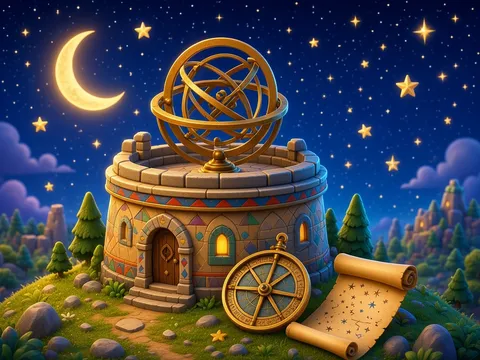
Muhammad Nasir al-Din Tusi (1201–1274) was one of the most outstanding scholars of the Middle Ages. Born in the city of Tus, he later lived and worked in Maragheh in Azerbaijan. Tusi wrote works on astronomy, mathematics, philosophy, geography, medicine and ethics. In 1259, on his initiative and under his direction, building began on an observatory on a hill near Maragheh. The Maragheh Observatory was one of the greatest centres of science of its time: it had large instruments for observing the sky, a rich library and scholars from many countries. Years of observations there produced astronomical tables called the Ilkhanic Tables (Zij-i Ilkhani). Tusi is regarded as one of the first to set out trigonometry as a science of its own, separate from astronomy. His book “Akhlaq-i Nasiri” sets out his ideas on upbringing and ethics. Today the observatory’s remains are protected, a crater on the Moon is named after Tusi, and the Shamakhy Astrophysical Observatory bears his name.
 What the book shows

In grade 5 the History of Azerbaijan course begins with an introduction to history and briefly covers the country’s past from ancient times to today: the oldest human sites, ancient states, the Middle Ages, the khanates, the Democratic Republic and the restoration of independence. Read the topic in the textbook, look at the maps and pictures, and write the dates in your notebook.
Textbook link:
This is not the textbook’s text but a short description of the topic. Check the exact page in your own textbook.
 The lesson step by step
- 1
Warm-up5 min
The night sky: how do we measure stars?
- 2
New topic10 min
Who Tusi was.
- 3
Practice10 min
The Maragheh Observatory.
- 4
Game10 min
Tusi’s scientific legacy.
- 5
Wrap-up5 min
Making a science card.
 Let’s understand
For the student Simple language
| Field | Tusi’s work |
|---|---|
| astronomy | the observatory, the Ilkhanic Tables |
| mathematics | trigonometry as its own science |
| ethics | Akhlaq-i Nasiri |
 For the parent
How to help
- On a clear night look at the stars together and note the Moon’s shape over several days: a small taste of Tusi’s work.
 For the teacher
 Lesson goals
- Know that Nasir al-Din Tusi was a great 13th-century scholar, explain the founding and importance of the Maragheh Observatory, and list the fields he worked in.
How to teach it
- Working with sources and maps, timelines, discussion, mini-project
 Differentiation
- Weaker pupils work with key dates and pictures; stronger pupils compare sources and write their own conclusion
 Questions for the class
- Why was the Maragheh Observatory an important centre of science?
 How to check
The pupil gives Tusi’s dates, explains the founding and importance of the observatory and names his main work.
 Scientific Scientific language
What is an observatory?
A science centre that watches the Sun, Moon, stars and planets.
No telescopes!
The telescope had not been invented in the 13th century; scholars measured with large angle-measuring instruments.
Self-study
Step by step
- I said who Tusi was.
- I knew when the observatory was founded.
- I listed his fields.
- I said how he is remembered.
Going deeper
 Scientific language: for older students, parents and teachers.
Observations made at Maragheh influenced astronomers in both East and West in later centuries.
 Play and check
True or false?
 How to write it down
- Make a “science card” with 5 facts about Tusi.
- Draw a simple picture of the observatory.
How the classwork looks in the notebook
Sample: the date and heading follow this country’s notebook rules.
 Watch out: common mistakes
 Where it helps in life
- The Azerbaijani khanates
 At home
Core
- Write 6 sentences about Tusi.
Extra ⭐
- Draw the Moon every evening for a week and note how it changes.
How to do it
- Read the topic in the textbook.
- Write the key dates and names in your notebook and add them to your timeline.
Answers for parents
Facts: 1201–1274; worked in Maragheh; observatory from 1259; the Ilkhanic Tables; trigonometry; Akhlaq-i Nasiri; a Moon crater; the Shamakhy observatory bears his name.
Step-by-step homework solution — Show the solution (try it yourself first)
Think
- How can you study the stars without a telescope? Very carefully and for a long time! At Tusi’s observatory scholars measured and recorded the positions of stars and planets night after night for years. Patience and accuracy are the basis of science.
How the homework looks in the notebook
Sample: the date and heading follow this country’s notebook rules.

 About cookies