


Throwing a small ball


 About this lesson
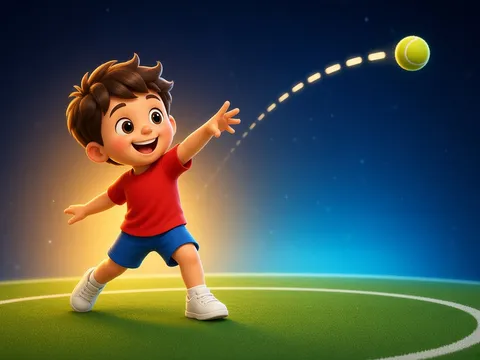
Throwing a small ball prepares pupils for throwing events in athletics. Hold the ball in your fingers, not squeezed in your palm. Stand sideways: if you throw with your right hand, your left foot is in front. Draw the straight arm back and lean back a little. Then the movement travels upwards from the legs: the leg pushes, the body turns forward, then the shoulder, elbow and finally the hand release the ball over your head, forward and up. The ball flies far when released at an angle a little under 45°. After the throw keep your balance so you don’t step over the line. In a running throw the last steps are cross-over steps. The throw is measured from the throwing line to where the ball first lands. Safety: everyone stays behind the line, throw only on the teacher’s signal, and nobody throws while balls are being collected.
 What the book shows

In grade 5 PE covers athletics (long jump, throwing a small ball) and basic technique in team games (basketball, football). Each lesson has a warm-up, technique learned in stages, a game and a cool-down.
Textbook link:
This is not the textbook’s text but a short description of the topic. Check the exact page in your own textbook.
 The lesson step by step
- 1
Warm-up5 min
Warm-up: shoulders and arms.
- 2
New topic10 min
Grip and stance.
- 3
Practice10 min
Standing throw.
- 4
Game10 min
Target game.
- 5
Wrap-up5 min
Measuring and cool-down.
 Let’s understand
For the student Simple language
| Step | What do we do? |
|---|---|
| 1 | hold the ball in your fingers |
| 2 | stand sideways, opposite foot forward |
| 3 | draw your straight arm back |
| 4 | leg → body → arm → hand |
| 5 | keep your balance |
 For the parent
How to help
- Play a target-throwing game with a small ball in an empty yard or park. Make sure nobody is nearby.
 For the teacher
 Lesson goals
- Know and perform the overarm throw with a small ball: grip, drawing the arm back, turning the body, the release and keeping balance, while following safety rules.
How to teach it
- Demonstration, step-by-step learning, pair and group drills, games, self-assessment
 Differentiation
- Weaker pupils: easier version and shorter distance; stronger pupils: an extra challenge
 Questions for the class
- How can you throw a small ball further?
 How to check
The pupil grips correctly, stands sideways, passes the movement from legs to hand and follows the safety rules.
 Scientific Scientific language
Why does the angle matter?
Too low and the ball lands soon; too high and it goes up more than forward; a middle angle goes furthest.
Like a whip
As the movement passes from leg to hand, each part adds speed, like the tip of a whip.
Self-study
Step by step
- I held the ball correctly.
- I stood sideways.
- I passed the movement from legs to hand.
- I threw only on the signal.
Going deeper
 Scientific language: for older students, parents and teachers.
The same legs-to-hand chain is used in the javelin, a volleyball spike and a tennis serve.
 Play and check
Right or wrong?
 How to write it down
- Show the 5 steps of the throw in pictures.
- Draw the ball’s flight path as an arc.
How the classwork looks in the notebook
Sample: the date and heading follow this country’s notebook rules.
 Watch out: common mistakes
 Where it helps in life
- Basketball: shooting
 At home
Core
- Throw a small ball at a target on a wall 10 times and record the hits.
Extra ⭐
- Write 3 safety rules for throwing.
How to do it
- Do the exercise in a safe place with a grown-up nearby.
- Then drink water and rest.
Answers for parents
Rules: stay behind the line; throw only on the signal; never throw while balls are collected; check nobody is in front before throwing.
Step-by-step homework solution — Show the solution (try it yourself first)
Work it out
- Leyla threw 18 m, 21 m and 24 m. Her average is (18 + 21 + 24) ÷ 3 = 63 ÷ 3 = 21 m.
How the homework looks in the notebook
Sample: the date and heading follow this country’s notebook rules.

 About cookies