


Football: passing


 About this lesson
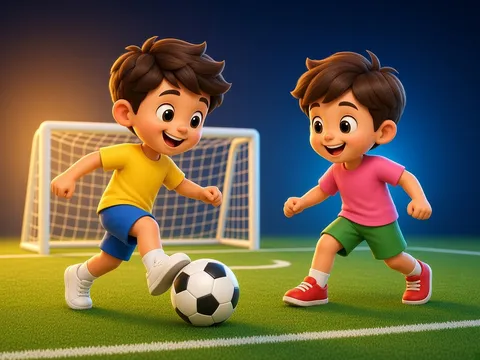
In football passing is a team’s main weapon: the ball moves faster than a running player. For a short, accurate pass use the inside of the foot, because its surface is wide and flat. Technique: put your standing foot beside the ball, about a hand’s width away, with the toes pointing where you want to pass. Bend the kicking leg slightly at the knee and turn it out so the inside of the foot meets the ball squarely. Strike the middle of the ball and follow through towards the target. Keep your body over the ball and your eyes on it as you strike. To stop (receive) the ball, put the inside of your foot in its path and draw it back slightly as the ball arrives, so it stops as if landing on a cushion. Look up to find a teammate before passing, and move to a new space after passing. In football only the goalkeeper may handle the ball, and only in their own penalty area.
 What the book shows

In grade 5 PE covers athletics (long jump, throwing a small ball) and basic technique in team games (basketball, football). Each lesson has a warm-up, technique learned in stages, a game and a cool-down.
Textbook link:
This is not the textbook’s text but a short description of the topic. Check the exact page in your own textbook.
 The lesson step by step
- 1
Warm-up5 min
Warm-up with the ball.
- 2
New topic10 min
Passing technique.
- 3
Practice10 min
Passing and receiving in pairs.
- 4
Game10 min
Triangle passing game.
- 5
Wrap-up5 min
Small-sided game and cool-down.
 Let’s understand
For the student Simple language
| Part | How? |
|---|---|
| standing foot | beside the ball, toes to the target |
| kicking foot | turned out, strikes with the inside |
| ball | struck in the middle |
| eyes | on the ball as you strike |
| receiving | foot gives a little |
 For the parent
How to help
- In the yard pass a ball to each other with the inside of the foot from 5–10 steps. Try to stop the ball each time before passing back.
 For the teacher
 Lesson goals
- Know and perform passing and stopping the ball with the inside of the foot: where the standing foot goes, the position of the kicking foot and watching the ball; pass accurately in pairs and small groups.
How to teach it
- Demonstration, step-by-step learning, pair and group drills, games, self-assessment
 Differentiation
- Weaker pupils: easier version and shorter distance; stronger pupils: an extra challenge
 Questions for the class
- How do you pass the ball accurately to a teammate?
 How to check
The pupil passes accurately with the inside of the foot, stops the ball and moves after passing.
 Scientific Scientific language
Why the inside?
The inside of the foot is the widest flat surface, so the ball goes exactly where you aim.
The cushion effect
Drawing the foot back keeps it in contact with the ball for longer and slows it gradually, so it doesn’t bounce away.
Self-study
Step by step
- I placed my standing foot correctly.
- I passed with the inside of my foot.
- I stopped the ball.
- I moved after passing.
Going deeper
 Scientific language: for older students, parents and teachers.
Professional players make many passes in a match; a team’s success depends more on accurate passing than on any single player.
 Play and check
Right or wrong?
 How to write it down
- Draw a diagram of the pass: standing foot, kicking foot, direction of the ball.
- Record how many of 20 pair passes were accurate.
How the classwork looks in the notebook
Sample: the date and heading follow this country’s notebook rules.
 Watch out: common mistakes
 Where it helps in life
- New game skills in grade 6
 At home
Core
- Make 20 inside-foot passes against a wall, stopping the ball each time it comes back.
Extra ⭐
- Write 2 sentences on why teamwork matters in football.
How to do it
- Do the exercise in a safe place with a grown-up nearby.
- Then drink water and rest.
Answers for parents
Example: the ball travels faster than a running player, so passing gets a team past opponents quickly. One player cannot beat a whole team alone.
Step-by-step homework solution — Show the solution (try it yourself first)
Work it out
- A pair made 16 accurate passes out of 20. That is 16/20 = 4/5, so 4 out of every 5 passes were accurate.
How the homework looks in the notebook
Sample: the date and heading follow this country’s notebook rules.

 About cookies