


Some and any


 About this lesson
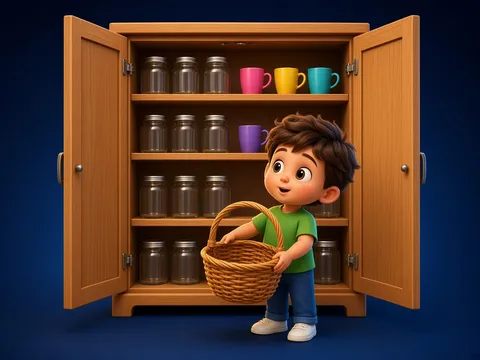
English nouns are countable or uncountable. Countable nouns can be counted: a cup, two cups; an egg, three eggs. Uncountable nouns cannot be counted and have no plural: water, milk, bread, rice, sugar, juice. Use some in positive sentences: There are some cups. There is some milk. Use any in negatives and questions: There aren’t any jars. Is there any sugar? Are there any eggs? Use some in offers and requests: Would you like some juice? Can I have some water, please? With a single countable noun use a/an instead: There is a cup.
 What the book shows

In grade 5 pupils describe what is happening now, describe a room and a town, give directions, compare things and talk about their plans. Each lesson has a grammar pattern, a word bank, a dialogue and a short piece of writing.
Textbook link:
This is not the textbook’s text but a short description of the topic. Check the exact page in your own textbook.
 The lesson step by step
- 1
Warm-up5 min
What is in the cupboard?
- 2
New topic10 min
Countable and uncountable.
- 3
Practice10 min
some and any.
- 4
Game10 min
Shop game.
- 5
Wrap-up5 min
A shopping list.
 Let’s understand
For the student Simple language
| countable | uncountable | |
|---|---|---|
| + | There are some cups. | There is some milk. |
| − | There aren’t any jars. | There isn’t any sugar. |
| ? | Are there any eggs? | Is there any water? |
 For the parent
How to help
- Write a shopping list in English together and ask: Is there any milk? Are there any eggs?
 For the teacher
 Lesson goals
- Tell countable from uncountable nouns, use some in positive sentences and any in negatives and questions, and make a shopping list and dialogue.
How to teach it
- Listening, picture description, pair dialogues, role play, short writing
 Differentiation
- Weaker pupils: a ready pattern and word bank; stronger pupils: a 6–8 sentence text
 Questions for the class
- How do we say what we have and don’t have at home?
 How to check
The pupil sorts nouns, uses some and any correctly and acts out a shop dialogue.
 Scientific Scientific language
Counting the uncountable
Add a container or measure: a glass of water, a bottle of milk, a loaf of bread, a kilo of rice.
Offers
In offers we say some because we expect “yes”: Would you like some tea?
Self-study
Step by step
- I sorted countable and uncountable nouns.
- I used some.
- I used any.
- I made a polite request.
Going deeper
 Scientific language: for older students, parents and teachers.
Some nouns are uncountable in English even if they can be counted in other languages: advice, information, homework. Say some homework, two pieces of advice.
 Play and check
Countable or uncountable?
 How to write it down
- Describe a kitchen cupboard: 3 sentences with some and 3 with any.
- Write a 6-item shopping list (a bottle of…, a kilo of…).
How the classwork looks in the notebook
Sample: the date and heading follow this country’s notebook rules.
 Watch out: common mistakes
 Where it helps in life
- Plans with going to
 At home
Core
- Write a 6-line shop dialogue: Can I have some…? Are there any…?
Extra ⭐
- Sort 10 nouns into countable and uncountable.
How to do it
- Read the sentences aloud.
- Read what you wrote to a grown-up.
Answers for parents
Example: A: Good morning! Can I have some bread, please? B: Here you are. A: Are there any eggs? B: Sorry, there aren’t any. A: Is there any milk? B: Yes, there is.
Step-by-step homework solution — Show the solution (try it yourself first)
Tell
- The cupboard in the picture: There are some jars. There are some cups. There aren’t any plates. Is there any juice? No, there isn’t.
How the homework looks in the notebook
Sample: the date and heading follow this country’s notebook rules.

 About cookies