


Azerbaijan · Grade 5
Subject guide: Mathematics
Grade 5 maths: natural numbers, divisibility rules, GCD and LCM, fractions and decimals, percentages, perimeter, area and volume, data. 5 hours a week (2025–2026 teaching plan).
Notebooks and supplies
- Squared notebook, 48 sheets — classwork; a separate thin squared one — homework; sometimes a test notebook (kept by the teacher).
- Blue pen (writing), pencil (drawings), eraser.
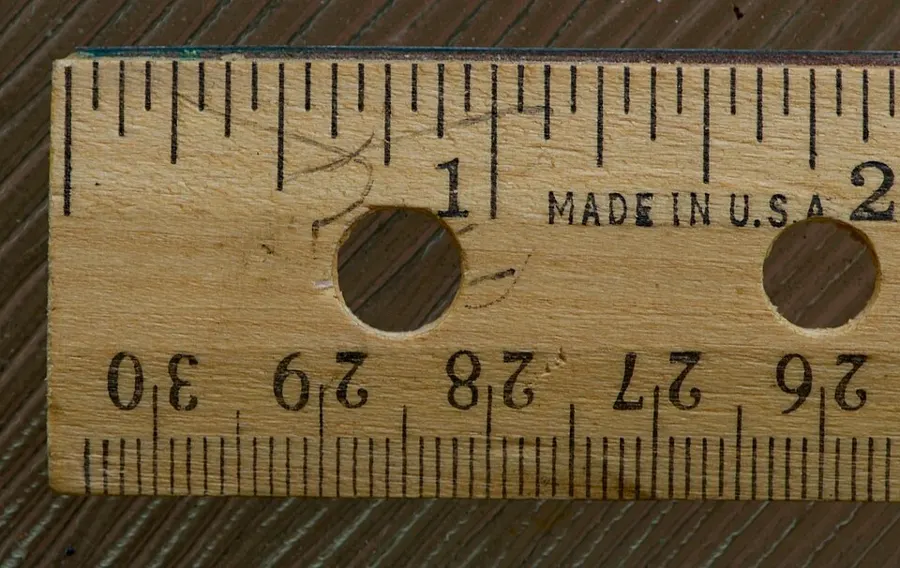
- Ruler 20–30 cm, protractor, compasses.
- A calculator only to check answers — calculation is learned by hand.
How to set up the notebook
- Before each piece of work: the date and “Classwork” / “Homework”.
- Word problems: “Given — Find — Solution — Answer”.
- Shapes and drawings only in pencil with a ruler.
What is studied and what to do
- Natural numbers: place value, comparing, rounding, four operations, order of operations.
- Divisibility: rules for 2, 3, 5, 9, 10; prime and composite numbers; GCD, LCM.
- Fractions: simplifying, comparing, adding, subtracting; mixed numbers.
- Decimals: writing, rounding, four operations.
- Percentages: a percent of a number, a number from its percent.
- Geometry: angles, triangles and quadrilaterals, perimeter, area, volume.
- Data: tables, charts, the mean.
What to do
- On the day of the lesson: write the rule in your own words + 1 example.
- Before homework, redo the worked example from the textbook.
- Check every answer: subtraction with addition, division with multiplication, fractions by simplifying.
- Once a week, a “mistakes sheet”: your mistakes and the correct working.
The unit list is a draft; the exact order follows the class textbook.
Where it is used in real life
- Discounts: how much are 50-manat shoes at 20% off? (50 − 10 = 40 ₼)
- Home repairs: how many m² of flooring for a room — area.
- Kitchen: ½ or ¾ of a recipe — fractions.
- Aquarium: how many litres it holds — volume (1 dm³ = 1 l).
- Timetables: two buses come every 12 and 18 minutes — when together again? LCM = 36 minutes.
Diagrams
Calculators
Glossary of terms
| Term | Meaning |
|---|---|
| Natural number (natural ədəd) | Counting numbers: 1, 2, 3, … |
| Place value (mərtəbə) | A digit’s position: ones, tens, hundreds… |
| Rounding (yuvarlaqlaşdırma) | Replacing a number with a nearby round one. |
| Divisor (bölən) | A number that divides another exactly. |
| Multiple (bölünən) | A number divisible by the given one. |
| Remainder (qalıq) | What is left after dividing; smaller than the divisor. |
| Prime number (sadə ədəd) | A number > 1 divisible only by 1 and itself: 2, 3, 5, 7… |
| Composite number (mürəkkəb ədəd) | A number with more than two divisors. |
| GCD (ƏBOB) | Greatest common divisor. |
| LCM (ƏKOK) | Least common multiple. |
| Fraction (adi kəsr) | Equal parts of a whole: a/b. |
| Numerator (surət) | The top number — how many parts are taken. |
| Denominator (məxrəc) | The bottom number — how many parts in the whole. |
| Simplifying (ixtisar) | Dividing top and bottom by the same number. |
| Mixed number (qarışıq ədəd) | A whole part + a fraction: 2 ¾. |
| Decimal (onluq kəsr) | A fraction over 10, 100, 1000: 0.7. |
| Percent (faiz) | One hundredth: 1% = 1/100. |
| Perimeter (perimetr) | The total length of all sides. |
| Area (sahə) | The space a shape covers; in square units: cm². |
| Volume (həcm) | The space a solid fills; in cubic units: cm³. |
| Angle (bucaq) | Two rays from one point; measured in degrees. |
| Mean (ədədi orta) | The sum of the numbers divided by how many there are. |
 About cookies


