


Azerbaijani folk costume


 About this lesson
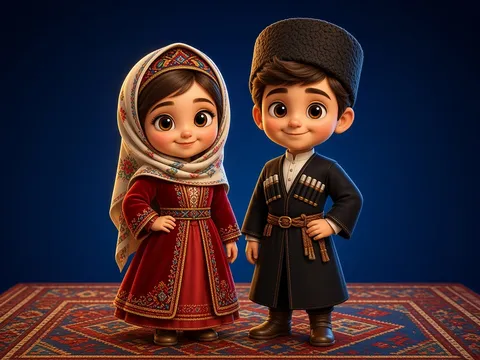
Folk costume tells of a people’s history, climate, work and taste. Women wore a fitted arkhalig or chapkan jacket with embroidered sleeves and hem, a wide gathered skirt, and a kelaghayi on the head. The kelaghayi is a patterned silk headscarf; the art of the kelaghayi is on UNESCO’s intangible heritage list. Men wore a chukha coat over the arkhalig; its chest had slots for cartridge cases. Men wore a papakha hat and a belt. Clothes were sewn from velvet, silk and broadcloth and decorated with gold and silver thread embroidery and ornamental buttons. Colours were often bright: red, dark green, blue and purple.
 What the book shows

In grade 5 visual arts focuses on folk and decorative art: costume, coats of arms, glass, metal, tapestry and batik. Each topic has example works, a discussion of them and a creative task.
Textbook link:
This is not the textbook’s text but a short description of the topic. Check the exact page in your own textbook.
 The lesson step by step
- 1
Warm-up5 min
What does clothing tell us?
- 2
New topic10 min
Women’s costume.
- 3
Practice10 min
Men’s costume.
- 4
Game10 min
Cloth, embroidery, colour.
- 5
Wrap-up5 min
Sketching.
 Let’s understand
For the student Simple language
| Garment | Who wears it? | What is it? |
|---|---|---|
| arkhalig | women, men | fitted jacket |
| chukha | men | long coat |
| skirt | women | wide and gathered |
| kelaghayi | women | silk headscarf |
| papakha | men | woolly hat |
 For the parent
How to help
- If you have an old kelaghayi or patterned cloth at home, look at it together and let your child draw the patterns. Museum websites show folk costume photos too.
 For the teacher
 Lesson goals
- Know the main parts of Azerbaijani folk costume, describe their decoration and colours, and sketch a costume.
How to teach it
- Looking and discussing, sketching, hands-on work, a mini-exhibition
 Differentiation
- Weaker pupils colour a ready outline; stronger pupils create their own composition
 Questions for the class
- What does folk costume tell us about a people?
 How to check
The pupil names the parts of folk costume and draws a decorated sketch.
 Scientific Scientific language
Why velvet and wool?
Mountain winters are cold, so warm cloth and woolly hats mattered.
Pattern meaning
Embroidery often shows buta, flowers and birds, symbols of life and plenty.
Self-study
Step by step
- I named the parts of folk costume.
- I told men’s and women’s dress apart.
- I described the decoration and colours.
- I drew a sketch.
Going deeper
 Scientific language: for older students, parents and teachers.
Today designers use folk costume elements (patterns, cuts, colours) in modern clothes too.
 Play and check
Men’s or women’s dress?
 How to write it down
- Sketch women’s and men’s folk costume and label the parts.
- Choose colours and add an embroidery pattern.
How the classwork looks in the notebook
Sample: the date and heading follow this country’s notebook rules.
 Watch out: common mistakes
 Where it helps in life
- Heraldry
 At home
Core
- Draw your own kelaghayi pattern on a square sheet with motifs in the corners and centre.
Extra ⭐
- Find a family memory or photo connected with folk costume and talk about it.
How to do it
- Prepare a quiet spot and materials.
- Show your work to a grown-up and explain it.
Answers for parents
Check: the pattern is symmetrical, the same motif repeats in the corners, there is a main motif in the centre, and the colours go well together.
Step-by-step homework solution — Show the solution (try it yourself first)
Think
- A costume’s colour and decoration could show the wearer’s age, region and whether it was festive or everyday: festive clothes were brighter and richer.
How the homework looks in the notebook
Sample: the date and heading follow this country’s notebook rules.

 About cookies