


Ratio


 About this lesson
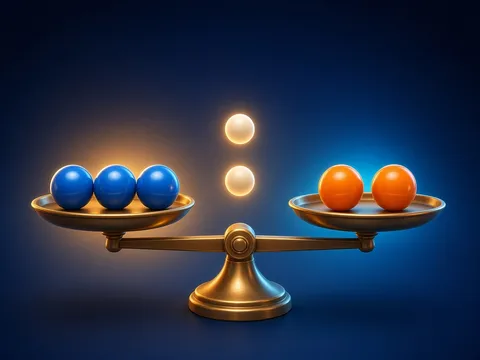
A ratio shows how many times bigger one number is than another, or what part one is of the other. With 3 blue and 2 orange marbles, the ratio of blue to orange is 3 : 2 (“three to two”). 3 and 2 are the terms of the ratio. A ratio can also be written as a fraction: 3/2. Multiplying or dividing both terms by the same number does not change the ratio: 12 : 8 = 3 : 2 (both divided by 4). Before comparing quantities, put them in the same unit: 50 cm to 2 m is 50 cm : 200 cm = 1 : 4. To share a quantity in a ratio, add the terms to get the number of parts. Sharing 30 manat in the ratio 2 : 3 gives 5 parts, so one part is 30 ÷ 5 = 6 manat; the first brother gets 2 · 6 = 12 and the second 3 · 6 = 18 manat. Check: 12 + 18 = 30. Order matters: 3 : 2 is not the same as 2 : 3.
 What the book shows

The grade 6 maths textbook comes in two parts: natural numbers, ratio, proportion and percent, integers, the coordinate plane, sets, equations, triangles, area and volume, statistics and probability. Each unit starts with a warm-up check, and each topic gives a rule, a worked example and tasks. Read the example first, say the rule in your own words, then solve the tasks in your notebook and check the answer.
Textbook link:
This is not the textbook’s text but a short description of the topic. Check the exact page in your own textbook.
 The lesson step by step
- 1
Warm-up5 min
Blue and orange marbles.
- 2
New topic10 min
What a ratio is.
- 3
Practice10 min
Simplifying and units.
- 4
Game10 min
Sharing in a ratio.
- 5
Wrap-up5 min
The lemonade problem.
 Let’s understand
For the student Simple language
| Situation | Ratio | Simplest form |
|---|---|---|
| 12 girls, 8 boys | 12 : 8 | 3 : 2 |
| 50 cm and 2 m | 50 : 200 | 1 : 4 |
| 15 min and 1 h | 15 : 60 | 1 : 4 |
| 30 manat, 2 : 3 | 12 : 18 | 2 : 3 |
 For the parent
How to help
- Choose a recipe and double or halve it together, keeping the ratio the same.
 For the teacher
 Lesson goals
- Write and read a ratio, simplify it, convert quantities to the same unit to compare them, and share a quantity in a given ratio.
How to teach it
- Modelling, worked examples, pair problem-solving, estimating and checking, independent work
 Differentiation
- Weaker pupils work step by step from a model; stronger pupils solve multi-step problems and write their own
 Questions for the class
- How can we compare two quantities?
 How to check
The pupil writes, reads and simplifies ratios, converts to the same unit and shares quantities in a given ratio.
 Scientific Scientific language
Mixing paint
Mix paint 1 : 3 (1 part white, 3 parts blue) and the colour stays the same however big the batch.
Recipes
Keep the ratio 2 cups of flour : 1 cup of water and the dough stays the same.
Self-study
Step by step
- I wrote and read a ratio.
- I simplified it.
- I converted to the same unit.
- I shared in a ratio.
Going deeper
 Scientific language: for older students, parents and teachers.
Screen shapes are given as ratios too: 16 : 9 means the width is about 1.8 times the height.
 Play and check
What is the ratio in its simplest form?
 How to write it down
- Simplify 18 : 24; 35 : 14; 100 : 75.
- Convert and simplify: 30 cm : 1 m; 40 min : 2 h.
- Share 45 kg of potatoes between two sacks in the ratio 4 : 5.
How the classwork looks in the notebook
Sample: the date and heading follow this country’s notebook rules.
 Watch out: common mistakes
 Where it helps in life
- Proportion
 At home
Core
- Write and simplify the ratio of girls to boys in your class and of textbooks to story books on your shelf.
Extra ⭐
- Share 56 manat in the ratio 3 : 4.
How to do it
- Solve the tasks in your notebook.
- Check each answer by estimating or with the inverse operation.
Answers for parents
3 : 4; 5 : 2; 4 : 3. 30 : 100 = 3 : 10; 40 : 120 = 1 : 3. 9 parts of 5 kg: 20 kg and 25 kg. Homework: 7 parts of 8 manat: 24 and 32 manat.
Step-by-step homework solution — Show the solution (try it yourself first)
Let’s solve
- Lemonade needs 1 part juice to 4 parts water. How much juice for 2 litres? 1 + 4 = 5 parts; one part is 2000 ml ÷ 5 = 400 ml. Juice 400 ml, water 1600 ml. Check: 400 + 1600 = 2000 ml.
How the homework looks in the notebook
Sample: the date and heading follow this country’s notebook rules.

 About cookies