


Angles in a triangle


 About this lesson
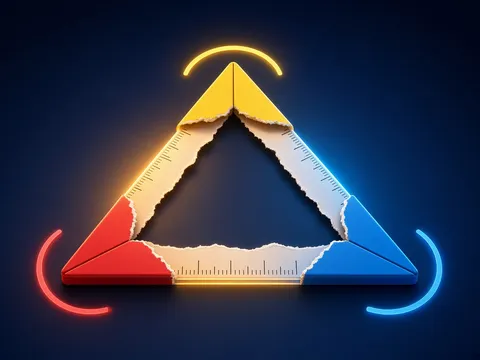
Cut any triangle out of paper, tear off its three corners and put them together with the points meeting: they form a straight angle, a straight line. A straight angle is 180°. So the angles of any triangle add up to 180°. When you measure with a protractor, small errors may give 178° or 181°, but the true sum is always 180°. This lets us find a missing angle: if two angles are 50° and 70°, the third is 180° − 50° − 70° = 60°. By their angles, triangles come in three kinds: acute (all angles less than 90°), right-angled (one angle of 90°) and obtuse (one angle greater than 90°). A triangle can’t have two right angles or two obtuse angles, because the sum would be more than 180°. In a right-angled triangle the two acute angles add up to 90°. An equilateral triangle has three equal angles: 180° ÷ 3 = 60°. In an isosceles triangle the two base angles are equal: if the top angle is 40°, each of the others is (180° − 40°) ÷ 2 = 70°.
 What the book shows

The grade 6 maths textbook comes in two parts: natural numbers, ratio, proportion and percent, integers, the coordinate plane, sets, equations, triangles, area and volume, statistics and probability. Each unit starts with a warm-up check, and each topic gives a rule, a worked example and tasks. Read the example first, say the rule in your own words, then solve the tasks in your notebook and check the answer.
Textbook link:
This is not the textbook’s text but a short description of the topic. Check the exact page in your own textbook.
 The lesson step by step
- 1
Warm-up5 min
Torn corners make a straight line.
- 2
New topic10 min
The sum is 180°.
- 3
Practice10 min
Finding a missing angle.
- 4
Game10 min
Kinds by angle.
- 5
Wrap-up5 min
The ratio problem.
 Let’s understand
For the student Simple language
| Known angles | Working | Third angle, type |
|---|---|---|
| 50°, 70° | 180° − 120° | 60°, acute |
| 90°, 35° | 180° − 125° | 55°, right-angled |
| 110°, 30° | 180° − 140° | 40°, obtuse |
| 60°, 60° | 180° − 120° | 60°, equilateral |
 For the parent
How to help
- Look for triangles at home or outside (a coat hanger, a roof, a road sign) and decide together what kind of angles they have.
 For the teacher
 Lesson goals
- Check by measuring and by cutting that the angles of a triangle add up to 180°, work out a missing angle, and classify triangles by their angles.
How to teach it
- Modelling, worked examples, pair problem-solving, estimating and checking, independent work
 Differentiation
- Weaker pupils work step by step from a model; stronger pupils solve multi-step problems and write their own
 Questions for the class
- What do the angles of any triangle add up to?
 How to check
The pupil checks the 180° sum, works out missing angles and classifies triangles by their angles.
 Scientific Scientific language
Bridges and roofs
Triangle frames (trusses) are rigid — a triangle can’t change shape without changing its sides — so they are used in bridges and roofs.
Navigation
Ships and planes have long worked out directions from the angles of triangles.
Self-study
Step by step
- I checked the 180° sum.
- I found a missing angle.
- I classified a triangle.
- I found angles in an isosceles triangle.
Going deeper
 Scientific language: for older students, parents and teachers.
A quadrilateral can be split into two triangles by a diagonal, so its angles add up to 2 · 180° = 360°.
 Play and check
What kind of triangle has these angles?
 How to write it down
- Find the third angle: 45° and 85°; 100° and 25°; 90° and 18°.
- The top angle of an isosceles triangle is 50°. Find the base angles.
- Draw three different triangles, measure their angles with a protractor and add them up. What do you notice?
How the classwork looks in the notebook
Sample: the date and heading follow this country’s notebook rules.
 Watch out: common mistakes
 Where it helps in life
- Circumference and area of a circle
 At home
Core
- Cut a triangle from paper, tear off its corners and stick them along a straight line.
Extra ⭐
- In a right-angled triangle, one acute angle is 20° bigger than the other. Find the angles.
How to do it
- Solve the tasks in your notebook.
- Check each answer by estimating or with the inverse operation.
Answers for parents
50°; 55°; 72°. (180° − 50°) ÷ 2 = 65°. The sums come out close to 180°. Homework: x + x + 20° = 90°, x = 35°: 35°, 55° and 90°.
Step-by-step homework solution — Show the solution (try it yourself first)
Let’s solve
- A triangle’s angles are in the ratio 1 : 2 : 3. Find them. That is 1 + 2 + 3 = 6 parts, and one part is 180° ÷ 6 = 30°. The angles are 30°, 60° and 90° — a right-angled triangle.
How the homework looks in the notebook
Sample: the date and heading follow this country’s notebook rules.

 About cookies