


Circle, triangle, square, rectangle

 About this lesson
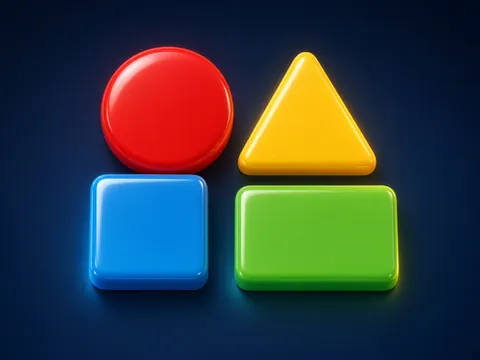
We recognise circles, triangles, squares and rectangles and count their sides and corners.
 The lesson step by step
- 1
Looking around5 min
We look for round, triangular and rectangular things in the classroom.
- 2
Names and corners8 min
We count corners: triangle 3, square 4, circle 0.
On the board△ 3 corners · □ 4 · ○ 0 - 3
Square and rectangle8 min
A square has 4 equal sides; a rectangle’s opposite sides are equal.
- 4
Drawing in the notebook9 min
We draw shapes along the squares with a ruler and colour them.
In the notebook□ 2×2 ▭ 4×2 △ - 5
A picture from shapes5 min
We build a house from shapes. The homework is explained.
 Let’s understand
For the student Simple language
Look around: everything has a shape!
Know the shapes
- Circle: round, no corners. It rolls!
- Triangle: 3 sides and 3 corners.
- Square: 4 sides, all equal.
- Rectangle: 4 sides, two long and two short.
Shapes at home
 ballcircle
 pizza slicetriangle
 picture framerectangle
 gift boxsquare
 For the parent
How to help
- On a walk, go “shape hunting”: road signs, windows, wheels.
- A rotated square may be called a diamond; count the corners together.
- Cut shapes from paper and build a house or a robot.
What to check
- Names the 4 shapes.
- Counts sides and corners.
- Explains the difference between a square and a rectangle.
A 5-minute game
 For the teacher
 Lesson goals
- Name and recognise basic shapes.
- Count sides and corners.
How to teach it
- A shape hunt in the classroom: window, clock, board.
- Build shapes from sticks: 3 make a triangle, 4 a square.
- Show shapes in different positions: a turned square is still a square.
 Differentiation
- For those who struggle: paper cut-outs to hold.
- For fast finishers: make a square from two triangles.
 Questions for the class
- Does a circle have corners?
- How is a square different from a rectangle?
 How to check
The child names 4 shapes and the number of sides of each.
 Scientific Scientific language
The core idea
A polygon is a shape bounded by a closed broken line; it has sides and vertices (corners). A triangle has 3 sides, a quadrilateral 4. A rectangle has all right angles; a square is a rectangle with equal sides. A circle is the region inside a circumference and is not a polygon.
Van Hiele levels
A first-grader is usually at level 0, recognising a shape by its overall look. The aim is level 1: recognising by properties (number of sides and corners). So show shapes in different sizes and rotated (as the game does).
Assessment criterion
The child names rotated shapes of various sizes correctly and justifies the choice by counting corners.
 Self-study
Step-by-step plan
- Count each shape’s corners with your finger.
- Find one object of each shape in your room.
- Recognise 6 shapes in the game.
- Draw them with a ruler in your notebook.
Check yourself: I can
- Name the 4 shapes.
- Recognise a shape by its corners.
- Recognise it even when it is turned.
Going deeper
 Scientific language: for older students, parents and teachers.
A polygon is a closed line made of straight segments: the segments are sides, the joining points are vertices. A circle is every point at the same distance from the centre. A square is a special rectangle with all sides equal.
Research: Dutch educators Pierre van Hiele and Dina van Hiele-Geldof described levels of geometric thinking: children first recognise a shape by its look, later by its properties (sides, angles).
 Play and check
The shape may be turned. Count the corners and choose its name.
 How to write it down
- Draw the square on the grid: 3 squares right, 3 down…
- Rectangle: 5 squares long, 3 wide.
- For a triangle, mark 3 dots and join them with a ruler.
- Trace a circle around the bottom of a cup.
How the classwork looks in the notebook
Sample: the date and heading follow this country’s notebook rules.
 Watch out: common mistakes
 Where it helps in life
- Measuring: perimeter and area (grade 3).
- Drawing: every picture starts with shapes.
- Life: road signs, tiles, buildings.
 At home
Core
- Find 2 things of each shape at home and write (or draw) them.
- Draw and colour the 4 shapes in your notebook.
Challenge ⭐
- Make a picture from shapes (a house, a robot) and count the triangles.
- Cut a square into two triangles with one line.
How to do it
- Hunt at home: 2 things per shape: a clock (circle), a book (rectangle), half a sandwich (triangle), a cube face (square).
- In the notebook: a square is 2 × 2 squares, a rectangle 4 × 2. Trace a circle round the bottom of a cup.
- Challenge: draw one line from one corner of a square to the opposite corner — you get two triangles.
Answers for parents
A line from one corner to the opposite corner (a diagonal) cuts a square into two triangles.
Step-by-step homework solution — Show the solution (try it yourself first)
Two things of each shape at home
- Circle: a plate, a clock. Square: a napkin, a face of a block. Rectangle: a door, a book. Triangle: half a sandwich, a coat hanger.
Draw the 4 shapes
- Square: 3 squares right, 3 down, 3 left, 3 up. Rectangle: 5 squares long and 3 wide.
- Triangle: mark 3 dots and join them with a ruler. Circle: trace around the bottom of a cup.
⭐ Cut a square into two triangles
- Draw a straight line from one corner to the opposite corner (a diagonal). Each part has 3 sides and 3 corners: two triangles.
How the homework looks in the notebook
Sample: the date and heading follow this country’s notebook rules.

 About cookies