


Plants

 About this lesson
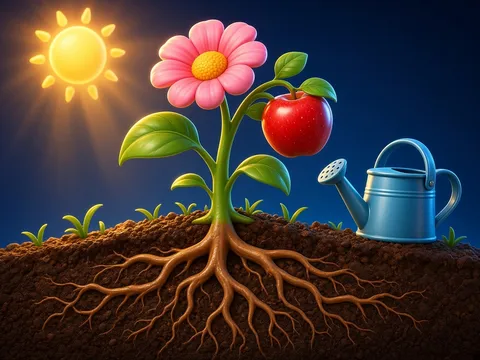
A plant is alive: it feeds, grows and reproduces. It needs water, light, air and soil.
 What the book shows

The textbook usually presents the topic with a big picture, questions and a small practical task. Talk about the picture and link the questions to your child’s life.
Textbook link:
This is not the textbook’s text but a short description of the topic. Check the exact page in your own textbook.
 The lesson step by step
- 1
Picture5 min
Plant parts.
- 2
A real plant10 min
Looking at roots and leaves.
- 3
Game10 min
Which part do we eat?
- 4
Experiment10 min
Planting beans.
- 5
Wrap-up5 min
What does a plant need?
 Let’s understand
For the student Simple language
The picture shows all the parts of a plant, with the sun and a watering can.
 root: takes water from the soil and holds the plant
 stem: carries water up
 leaf: makes food using sunlight
 flower: seeds form here
 fruit: holds the seeds
What does a plant need?
 water ·
 light ·
 air ·
 soil
 For the parent
How to help
- Sprout a bean or pea together.
- Put your child in charge of a houseplant.
- On walks compare trees, bushes and grasses.
 For the teacher
 Lesson goals
- Plant parts and needs.
How to teach it
- Real plant, experiment, sorting.
 Differentiation
- Stronger pupils: photosynthesis.
 Questions for the class
- Why can’t we live without plants?
 How to check
The pupil names 5 parts and 4 needs.
 Scientific Scientific language
Photosynthesis
Green leaves use sunlight, water and carbon dioxide from the air to make sugar (food) and release oxygen. This is photosynthesis. The green colour comes from chlorophyll, which is why a plant kept in the dark turns yellow.
Self-study
Step by step
- Point to 5 parts of a plant.
- Say what each does.
- Name 4 things a plant needs.
Going deeper
 Scientific language: for older students, parents and teachers.
Plants release oxygen during photosynthesis: much of the oxygen we breathe comes from plants and algae.
The pomegranate is one of Azerbaijan’s symbols; the Goychay district holds a Pomegranate Festival every year.
 Play and check
Which part of the plant is this?
 How to write it down
- Draw a plant.
- Label the parts with arrows.
How the classwork looks in the notebook
Sample: the date and heading follow this country’s notebook rules.
 Watch out: common mistakes
 Where it helps in life
- Science: photosynthesis, seed to plant.
- Healthy food: fruit and vegetables.
 At home
Core
- Put a bean on damp cotton wool and look every day. What changes?
Challenge ⭐
- Sprout two seeds, one in light and one in the dark. Draw the difference.
How to do it
- Draw it every day.
- Keep the cotton wool damp.
Answers for parents
After a few days a root appears, then a shoot. The shoot in the dark is pale and stretched.
Step-by-step homework solution — Show the solution (try it yourself first)
Observation
- The plant leans towards the window. Why? It grows towards the light.
How the homework looks in the notebook
Sample: the date and heading follow this country’s notebook rules.

 About cookies