


Domestic and wild animals


 About this lesson
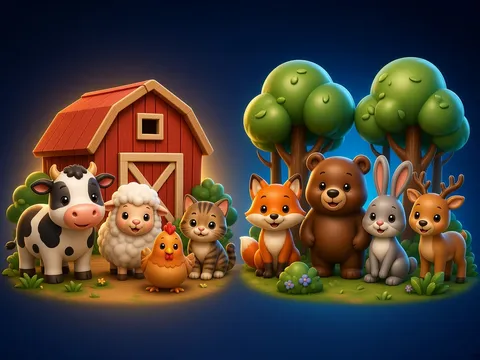
People look after domestic animals, giving them food and shelter. Wild animals live in nature and find their own food.
 What the book shows

The textbook usually presents the topic with a big picture, questions and a small practical task. Talk about the picture and link the questions to your child’s life.
Textbook link:
This is not the textbook’s text but a short description of the topic. Check the exact page in your own textbook.
 The lesson step by step
- 1
Picture5 min
Farm and forest.
- 2
Difference10 min
Who looks after them?
- 3
Game10 min
Sorting.
- 4
Uses10 min
What animals give us.
- 5
Wrap-up5 min
Riddles.
 Let’s understand
For the student Simple language
One side of the picture is a farm: cow, sheep, hen, cat. The other is a forest: fox, bear, hare, deer.
Wild: fox, bear, wolf, hare, deer, squirrel.
 For the parent
How to help
- Choose a book or cartoon about animals.
- If you have a pet, care for it together.
- Watch animals on a farm or at the zoo.
 For the teacher
 Lesson goals
- Domestic vs wild, uses, safety.
How to teach it
- Picture, sorting, riddles.
 Differentiation
- Stronger pupils: habitats.
 Questions for the class
- Why shouldn’t we keep wild animals at home?
 How to check
The pupil names 3 animals from each group.
 Scientific Scientific language
Domestication
Over thousands of years people domesticated some animals; the dog is thought to be the oldest. Domestic animals depend on people for water, food, a clean place and care. Wild animals live in their own habitats: forests, mountains, grasslands.
Self-study
Step by step
- Name 3 domestic animals.
- Name 3 wild ones.
- What does a cow give us?
Going deeper
 Scientific language: for older students, parents and teachers.
Azerbaijan’s Red Book lists rare and endangered animals; the goitered gazelle (ceyran) is one, and reserves protect it.
The Karabakh horse is an old breed developed in Azerbaijan.
 Play and check
Domestic or wild?
 How to write it down
- Split the page into “domestic” and “wild”.
- Draw 2 animals on each side.
How the classwork looks in the notebook
Sample: the date and heading follow this country’s notebook rules.
 Watch out: common mistakes
 Where it helps in life
- Science: feeding and habitats.
- Red Book: rare animals.
 At home
Core
- Draw your favourite animal and write 2 sentences.
Challenge ⭐
- Write what each farm animal gives us: milk, wool, eggs…
How to do it
- Draw where the animal lives too.
- Check your sentences.
Answers for parents
cow: milk; sheep: wool and milk; hen: eggs; horse: work and transport; dog: guards the house.
Step-by-step homework solution — Show the solution (try it yourself first)
Riddle
- Red tail, sly eyes, lives in the forest. Who is it? A fox.
How the homework looks in the notebook
Sample: the date and heading follow this country’s notebook rules.

 About cookies