


Hygiene


 About this lesson
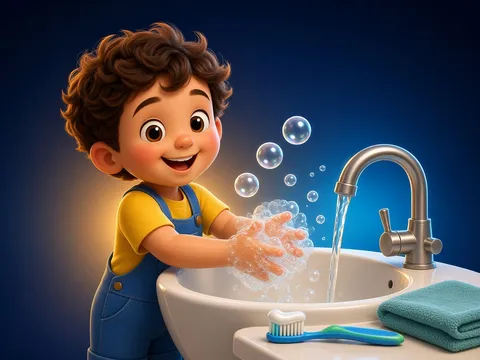
Hygiene means keeping your body clean. Clean hands and teeth protect us from germs and illness.
 What the book shows

The textbook usually presents the topic with a big picture, questions and a small practical task. Talk about the picture and link the questions to your child’s life.
Textbook link:
This is not the textbook’s text but a short description of the topic. Check the exact page in your own textbook.
 The lesson step by step
- 1
Picture5 min
What is the child doing?
- 2
Germs10 min
Pepper-and-soap experiment.
- 3
Handwashing10 min
Practising the 4 steps.
- 4
Game10 min
Personal and shared.
- 5
Wrap-up5 min
When do we wash hands?
 Let’s understand
For the student Simple language
In the picture a child washes their hands with soap; a toothbrush and towel are nearby.
How to wash your hands
- Wet your hands.
- Soap up: palms, between fingers, nails.
- Scrub for at least 20 seconds: sing “Happy Birthday” twice.
- Rinse and dry on a clean towel.
 Brush your teeth twice a day for 2 minutes.
 For the parent
How to help
- Put a handwashing steps picture by the sink.
- Use a 2-minute sand timer or song for brushing.
- Set an example.
 For the teacher
 Lesson goals
- Handwashing, dental hygiene, personal items.
How to teach it
- Experiment, practice, sorting.
 Differentiation
- Show steps with pictures.
 Questions for the class
- If we can’t see germs, how do we know they exist?
 How to check
The pupil shows the 4 steps and names 3 occasions.
 Scientific Scientific language
Germs
Germs are tiny living things too small to see; some cause illness. Soap lifts grease, dirt and germs off the skin, and water rinses them away. The World Health Organization recommends washing hands for at least 20 seconds. Toothbrushes, towels and combs are personal: we don’t share them.
Self-study
Step by step
- Say the 4 handwashing steps.
- When do we wash hands?
- How often do we brush teeth?
 Terms in this lesson
Tap an underlined word — its meaning opens in the glossary.
- Hygiene
- Rules of cleanliness.
- Living thing
- It feeds, grows and reproduces.
Going deeper
 Scientific language: for older students, parents and teachers.
In the 19th century the Hungarian doctor Ignaz Semmelweis showed that doctors washing their hands greatly reduced illness in hospital. Many rejected the idea then; today handwashing is a basic rule of medicine.
A simple class experiment: sprinkle black pepper on water and touch it with a soapy finger: the pepper “runs away”, showing soap’s power.
 Play and check
Personal or shared item?
 How to write it down
- Draw the 4 handwashing steps.
- Number the pictures.
How the classwork looks in the notebook
Sample: the date and heading follow this country’s notebook rules.
 Watch out: common mistakes
 Where it helps in life
- Healthy food.
- Science: germs, the human body.
 At home
Core
- For a week, tick morning and evening brushing on a chart.
Challenge ⭐
- Show your family the right way to wash hands.
How to do it
- Hang the chart by the sink.
- Tick each time.
Answers for parents
The chart should have 14 ticks: 7 days × 2.
Step-by-step homework solution — Show the solution (try it yourself first)
Situation
- You played with a cat outside and now it’s lunchtime. What do you do? Wash your hands with soap first.
How the homework looks in the notebook
Sample: the date and heading follow this country’s notebook rules.

 About cookies