


Healthy food

 About this lesson
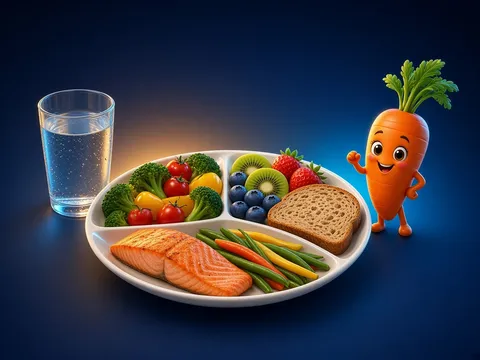
Our bodies need a variety of food: fruit and vegetables, grains, dairy, meat, fish, beans. Sweets only a little and now and then.
 What the book shows

The textbook usually presents the topic with a big picture, questions and a small practical task. Talk about the picture and link the questions to your child’s life.
Textbook link:
This is not the textbook’s text but a short description of the topic. Check the exact page in your own textbook.
 The lesson step by step
- 1
Picture5 min
What’s on the plate?
- 2
Groups10 min
Food groups.
- 3
Game10 min
Every day / sometimes.
- 4
Plate10 min
Drawing a balanced plate.
- 5
Wrap-up5 min
What will I have for breakfast?
 Let’s understand
For the student Simple language
The picture shows a balanced plate, a glass of water and a cheerful carrot.
 half: vegetables and fruit
 a quarter: grains: bread, rice, porridge
 a quarter: protein: meat, fish, eggs, beans
 dairy ·
 water
Eat less:
 sweets,
 fizzy sugary drinks,
 crisps.
 For the parent
How to help
- Take your child to the market to choose vegetables.
- Make a simple salad together.
- Keep water on the table.
 For the teacher
 Lesson goals
- Food groups, balanced plate, water.
How to teach it
- Picture, sorting, drawing.
 Differentiation
- Be mindful of food allergies.
 Questions for the class
- Why would we get ill eating only sweets?
 How to check
The pupil draws a balanced plate and names 3 groups.
 Scientific Scientific language
What does food give us?
Grains give energy, protein (meat, fish, eggs, beans) builds the body and helps it grow, fruit and vegetables give vitamins and fibre, dairy gives calcium for bones. Lots of sugar harms teeth. The “balanced plate” model is used in many countries’ health advice.
Self-study
Step by step
- What did you eat today?
- Were there vegetables on your plate?
- How many glasses of water did you drink?
Going deeper
 Scientific language: for older students, parents and teachers.
Azerbaijani cuisine is rich in vegetables and herbs: dolma, qutab and herbs served with plov are everyday dishes, which fits the “half the plate vegetables” advice well.
A child’s body is roughly 60–70% water, so drinking water really matters.
 Play and check
Every day or only sometimes?
 How to write it down
- Draw a plate and fill it in a balanced way.
- Label: vegetables, grains, protein.
How the classwork looks in the notebook
Sample: the date and heading follow this country’s notebook rules.
 Watch out: common mistakes
 Where it helps in life
- Science: food and energy.
- Maths: halves and quarters.
 At home
Core
- Draw what you ate in a day: breakfast, lunch, dinner.
Challenge ⭐
- Have a “rainbow day” with your family: eat fruit and veg of 5 colours.
How to do it
- Draw 3 meals.
- Circle the vegetables in green.
Answers for parents
Example: tomato (red), carrot (orange), banana (yellow), cucumber (green), aubergine (purple).
Step-by-step homework solution — Show the solution (try it yourself first)
Build a plate
- Choose: rice, chicken, salad, an apple, water. Is the plate balanced? Yes: grain, protein, vegetables, fruit, water.
How the homework looks in the notebook
Sample: the date and heading follow this country’s notebook rules.

 About cookies