


Road safety rules


 About this lesson
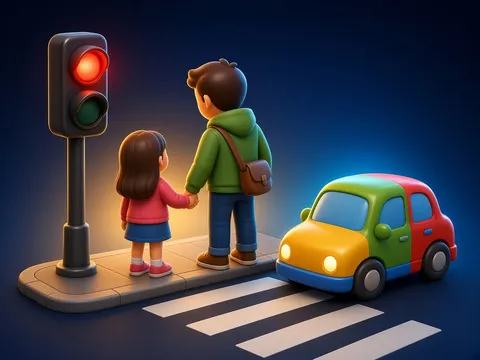
Road rules protect pedestrians and drivers. We cross only at a crossing, on green, and with an adult.
 What the book shows

The textbook usually presents the topic with a big picture, questions and a small practical task. Talk about the picture and link the questions to your child’s life.
Textbook link:
This is not the textbook’s text but a short description of the topic. Check the exact page in your own textbook.
 The lesson step by step
- 1
Picture5 min
Who is doing what?
- 2
Lights10 min
3 lights, game.
- 3
Crossing10 min
Practising on a class “zebra”.
- 4
Situations10 min
Dangerous / safe.
- 5
Wrap-up5 min
My way to school.
 Let’s understand
For the student Simple language
In the picture an adult and child wait at a red light; a car has stopped before the crossing.
 red: stop!
 amber: get ready, wait
 green: look, then cross
How to cross the road
- Go to a pedestrian crossing (a “zebra”).
- Stop at the edge of the pavement.
- Look left, then right, then left again.
- If no cars are coming, hold an adult’s hand and walk across calmly: don’t run!
Note: in Azerbaijan traffic drives on the right, so the nearest cars come from the left.
 For the parent
How to help
- Walk the school route together and point out dangers.
- Talk out loud while crossing: “Now I look left…”
- Attach a reflector to the backpack.
 For the teacher
 Lesson goals
- Traffic lights, crossings, safety.
How to teach it
- Role play, model zebra, sorting.
 Differentiation
- Every child practises in person.
 Questions for the class
- Why look even on green?
 How to check
The pupil names 3 lights and 4 steps.
 Scientific Scientific language
Why look left first?
Azerbaijan drives on the right, so when you cross, the nearest cars come from the left, and after the middle, from the right. Children can’t yet judge speed and distance well, so they should cross with an adult. In the dark, clothing should have reflectors.
Self-study
Step by step
- Name the 3 traffic-light colours.
- Say the 4 crossing steps.
- Why shouldn’t you run?
 Terms in this lesson
Tap an underlined word — its meaning opens in the glossary.
- Traffic light
- Red: stop, yellow: wait, green: go.
Going deeper
 Scientific language: for older students, parents and teachers.
One of the first electric traffic lights was installed in Cleveland, USA, in 1914. Today red, amber and green mean the same in most countries.
Red was chosen for “stop” because it is easy to see from afar and is linked with danger.
 Play and check
Safe or dangerous?
 How to write it down
- Draw and colour a traffic light.
- Write what each light means.
How the classwork looks in the notebook
Sample: the date and heading follow this country’s notebook rules.
 Watch out: common mistakes
 Where it helps in life
- Road signs: crossing, children.
- Behaviour on public transport.
 At home
Core
- Count the crossings on your way to school.
Challenge ⭐
- Draw the “pedestrian crossing” sign and spot it on the street.
How to do it
- Walk the route with an adult.
- Count the crossings.
Answers for parents
The pedestrian crossing sign: a blue square with a walking person in a white triangle.
Step-by-step homework solution — Show the solution (try it yourself first)
Situation
- Your ball rolls into the road. What do you do? Don’t chase it; tell an adult.
How the homework looks in the notebook
Sample: the date and heading follow this country’s notebook rules.

 About cookies