


Parts of a computer


 About this lesson
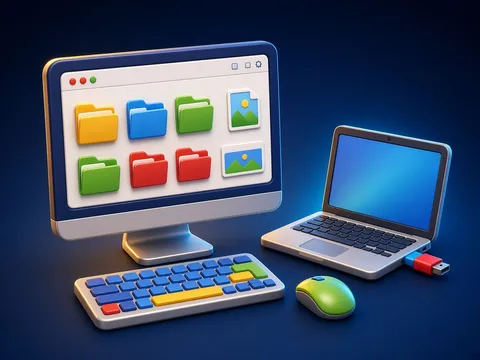
The monitor shows pictures and text. The keyboard types letters and numbers. The mouse moves the pointer and clicks. The system unit holds the computer’s “brain”. Headphones and speakers let us hear sound.
 What the book shows

In computer science the child first learns to think through unplugged games: recognising information, ordering steps and learning safety rules.
Textbook link:
This is not the textbook’s text but a short description of the topic. Check the exact page in your own textbook.
 The lesson step by step
- 1
Warm-up5 min
Riddle: what is it?
- 2
New topic10 min
5 parts.
- 3
Practice10 min
Input or output?
- 4
Game10 min
Build-a-computer game.
- 5
Wrap-up5 min
Point to a part.
 Let’s understand
For the student Simple language
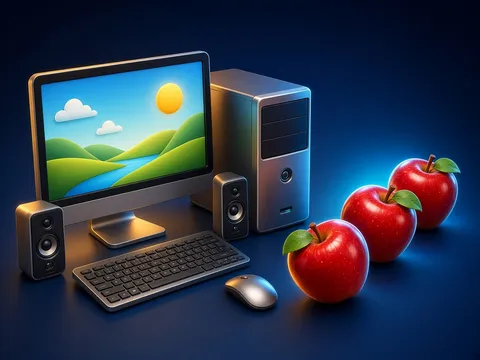
| Part | What it does |
|---|---|
| 🖥️ monitor | shows |
| ⌨️ keyboard | types |
| 🖱️ mouse | points and selects |
| 🗄️ system unit | works and stores |
| 🎧 headphones | bring sound |
 For the parent
How to help
- Name the parts of your home computer or laptop together.
- Show how to hold the mouse.
- Switch the computer on only with a grown-up.
 For the teacher
 Lesson goals
- Recognise the main parts of a computer (monitor, keyboard, mouse, system unit, headphones) and know what they do.
How to teach it
- Unplugged games, cards, role play, discussion
 Differentiation
- Weaker pupils: 2–3 steps; stronger pupils build their own algorithm
 Questions for the class
- What are the parts of a computer and what do they do?
 How to check
The pupil names 4–5 parts and their jobs.
 Scientific Scientific language
Input and output
Parts that give the computer information are input devices (keyboard, mouse, microphone). Parts that give us information are output devices (monitor, speakers, printer).
Laptop and tablet
A laptop has all parts in one case; on a tablet the screen also works as the keyboard.
Self-study
Step by step
- Point to the part.
- Say its name.
- Say what it does.
 Terms in this lesson
Tap an underlined word — its meaning opens in the glossary.
- Keyboard
- Keys for typing letters and numbers.
- Mouse
- A device that moves the pointer.
- Information
- What we know about the world around us.
- Algorithm
- A sequence of steps that reaches a goal.
Going deeper
 Scientific language: for older students, parents and teachers.
The computer mouse was invented in the 1960s by American engineer Douglas Engelbart. The first mouse was made of wood.
 Play and check
Does this part give information to the computer or to us?
 How to write it down
- Draw a computer and label 4 parts.
- Next to each write what it does.
How the classwork looks in the notebook
Sample: the date and heading follow this country’s notebook rules.
 Watch out: common mistakes
 Where it helps in life
- Safety rules
- Drawing with the mouse
 At home
Core
- Find the screen and buttons on a computer, phone or tablet at home.
Extra ⭐
- Ask your family what they use a computer for.
How to do it
- Do the task with a grown-up.
- Explain in words what you noticed.
Answers for parents
On a phone the screen both shows and takes touch commands. Family members may use a computer for work, messages, films or study.
Step-by-step homework solution — Show the solution (try it yourself first)
Find
- A microphone is input, a printer is output.
How the homework looks in the notebook
Sample: the date and heading follow this country’s notebook rules.

 About cookies