


Numbers 1, 2, 3


 About this lesson
 What the book shows

The textbook usually gives a picture example, a counting or comparing task and a short check. Talk about the picture first, then try the tasks with real objects.
Textbook link:
This is not the textbook’s text but a short description of the topic. Check the exact page in your own textbook.
 The lesson step by step
- 1
Movement5 min
Clap, two jumps, three spins.
- 2
Objects10 min
We count groups.
- 3
Digits10 min
Writing in the air, in sand, in notebooks.
- 4
Game10 min
Show a card, bring that many things.
- 5
Wrap-up5 min
1, 2, 3 around us.
 Let’s understand
For the student Simple language
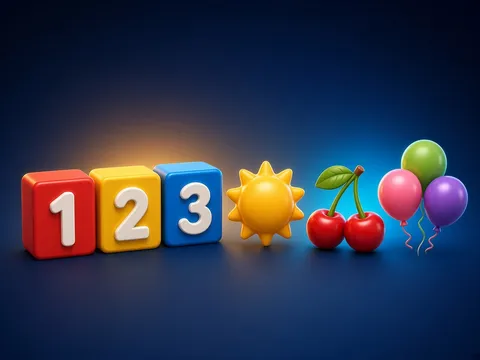
1 sun, 2 cherries, 3 balloons!
Writing the digits
1: a small hook at the top and a straight line down. 2: like a swan’s neck. 3: two half-circles stacked.
In Azerbaijani: bir, iki, üç.
 For the parent
How to help
- Count steps on the stairs.
- Give tasks like “Pass me 2 spoons.”
- Write digits with a finger in sand or flour.
 For the teacher
 Lesson goals
- Counting and writing 1–3.
How to teach it
- Movement, objects, multisensory writing.
 Differentiation
- Struggling pupils: trace digits over dots.
 Questions for the class
- Are a number and a digit the same thing?
 How to check
The pupil counts to 3 and writes the digit.
 Scientific Scientific language
Counting principles
Correct counting rests on a few principles: one number word per object, a fixed word order, the last word giving the size of the whole group, and the order of counting not changing the result. Small amounts (1–3) can be recognised at a glance without counting.
Self-study
Step by step
- Touch the things one by one.
- One word per touch.
- Repeat the last word: that is the answer.
- Write the digit in your notebook.
Going deeper
 Scientific language: for older students, parents and teachers.
Recognising a small amount at a glance is called subitising. Research shows people usually see up to 3–4 objects instantly without counting, which is why dice dots are so quick to read.
It matters to separate number (an amount) from digit (a written sign): 10 is written with two digits.
 Play and check
How many: 1, 2 or 3?
 How to write it down
- Write a row of each digit: 1, 2, 3.
- Next to each, draw that many circles.
How the classwork looks in the notebook
Sample: the date and heading follow this country’s notebook rules.
 Watch out: common mistakes
 Where it helps in life
- 4 and 5: counting on.
- Addition: 1 + 2 = 3.
 At home
Core
- Find 1, 2 and 3 matching things at home and draw them.
- Write a row of 1, 2, 3.
Challenge ⭐
- How many noses, eyes and ears do you have?
How to do it
- Start each digit at the top.
- One digit per square.
Answers for parents
⭐ 1 nose, 2 eyes, 2 ears.
Step-by-step homework solution — Show the solution (try it yourself first)
Count right
- Line the things up and count left to right, touching each.
How the homework looks in the notebook
Sample: the date and heading follow this country’s notebook rules.

 About cookies