


Comparing numbers: >, <, =

 About this lesson
We find which of two numbers is bigger or smaller and write it with >, < and =.
 What the book shows

In the textbook comparison usually starts with two groups of objects: we pair them up and find which has more. Then come the words “more”, “fewer”, “equal”, the signs >, < and =, comparing along the number line, and “put the sign” tasks.
Textbook link: Grade 1 “Mathematics”, unit “Numbers 1 to 10”. The exact page will be given after checking the official edition.
This is not the textbook’s text but a short description of the topic. Check the exact page in your own textbook.
 The lesson step by step
- 1
Who has more?5 min
Two children get different numbers of cubes. The class guesses who has more.
- 2
Pairing up8 min
We put cube against cube. Where some are left without a pair, there are more.
On the board● ● ● ● ● ● ● ● - 3
The signs8 min
The signs >, < and =. “The open side faces the bigger number.”
On the board3 < 5 7 > 4 6 = 6 - 4
On the number line9 min
The number further right is bigger. Children put signs in the notebook.
In the notebook4 < 7 9 > 2 5 = 5 - 5
Wrap-up5 min
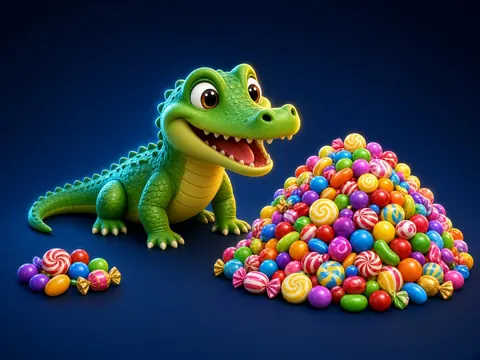
The crocodile game and explaining the homework.
 Let’s understand
For the student Simple language
Which plate has more apples? Let’s count!
 53
5 apples are more than 3. In maths we write 5 > 3.
The hungry crocodile
 The crocodile always opens its mouth towards the bigger number, because it wants to eat more! The pointy end faces the smaller number.
Check in pairs
Put things in pairs. The side left without partners has fewer. If everyone has a partner, they are equal.
 For the parent
How to help
- Compare at the table: “Whose plate has more spoons?”
- If the child hesitates, line things up in pairs; you can see it without counting.
- When writing a sign, ask: “Which number does the point face?”
What to check
- Uses “more”, “fewer”, “equal” correctly.
- Doesn’t mix up > and <.
- Puts = between equal numbers.
A 5-minute game
 For the teacher
 Lesson goals
- Compare numbers by counting objects.
- Write >, < and = correctly.
How to teach it
- Pair-matching: line items up one-to-one; the side with extras has more.
- Explain the sign as a “hungry crocodile” whose mouth opens to the bigger number.
- On a number line: further right means bigger.
 Differentiation
- For those who struggle: objects first, then digits.
- For fast finishers: order three numbers from smallest to largest.
 Questions for the class
- 7 or 9 — which is bigger? How do you know?
- Which sign do we use when they are equal?
 How to check
The child places the sign correctly in at least 5 of 6 pairs.
 Scientific Scientific language
The core idea
Two sets can be compared in two ways: one-to-one correspondence (pairing up) and counting. Pairing works even without counting and underpins “more”, “fewer” and “equal”. In the counting sequence each number is 1 more than the one before.
Curriculum link
Comparison runs alongside learning numbers to 10 and is the basis for addition/subtraction and place-value comparison to 20 and 100.
Techniques
- Concrete to abstract: objects → pictures → dots → digits.
- The “crocodile” is a memory aid, but the child should also state the rule: “the point faces the smaller number”.
- Comparing positions on a number line.
Assessment criterion
The child places the sign correctly in at least 9 of 10 pairs within 10 and explains the choice.
Self-study
Step-by-step plan
- Count and compare the apples in the picture.
- Say the crocodile rule in your own words.
- Solve 5 tasks in the game.
- Write in your notebook following the sample.
Check yourself: I can
- Say which of two numbers is bigger.
- Write >, <, = correctly.
- Explain my answer.
 Terms in this lesson
Tap an underlined word — its meaning opens in the glossary.
- Number
- Shows how many things there are.
- Number line
- A line with numbers in order.
- Side
- A straight edge of a shape.
- Digit
- A sign used to write numbers: 0–9.
- Addition
- Putting two groups together to find the total.
- Subtraction
- Taking part away from a group.
- Tens
- A group of 10 ones.
Going deeper
 Scientific language: for older students, parents and teachers.
Numbers form an ordered set: for any two numbers exactly one of a < b, a = b or a > b holds. The relation is transitive: if 3 < 5 and 5 < 8, then 3 < 8.
History: the “=” sign was proposed in 1557 by the Welsh mathematician Robert Recorde; “<” and “>” spread through a book by the English scholar Thomas Harriot, printed in 1631.
 Play and check
Count the dots and choose the right sign.
 How to write it down
- One example per line, one square between the numbers.
- Write the sign in the middle of its square.
- Finally check again by counting.
How the classwork looks in the notebook
Sample: the date and heading follow this country’s notebook rules.
 Watch out: common mistakes
 Where it helps in life
- Adding and subtracting: checking whether an answer makes sense.
- Grade 2: comparing numbers to 100 by tens.
- Life: comparing prices, ages, distances.
 At home
Core
- Put a sign: 4 _ 7, 9 _ 2, 5 _ 5, 0 _ 1.
- At home, pair up two groups of things (spoons, forks) and compare.
Challenge ⭐
- Which numbers fit 6 > _ ? (Write them all.)
- _ < 3 < _: find numbers for the gaps.
How to do it
- Put the sign: first say which number is bigger. Turn the open side (the crocodile’s mouth) towards the bigger one. Equal — “=”.
- Spoons and forks: put a fork next to every spoon. Whatever is left over has more. Write it, e.g. 5 > 3.
- Challenge: 6 > _ — every number less than 6: 0, 1, 2, 3, 4, 5.
Answers for parents
4 < 7, 9 > 2, 5 = 5, 0 < 1. 6 > 0, 1, 2, 3, 4, 5. For example: 2 < 3 < 4.
Step-by-step homework solution — Show the solution (try it yourself first)
4 _ 7, 9 _ 2, 5 _ 5, 0 _ 1
- On the number line the number further right is bigger. 4 is left of 7: 4 < 7.
- 9 is right of 2: 9 > 2. The open side faces the bigger number.
- 5 and 5 are the same: 5 = 5. 0 is smaller than any other: 0 < 1.
⭐ 6 > _
- Every number smaller than 6 fits: 0, 1, 2, 3, 4, 5.
How the homework looks in the notebook
Sample: the date and heading follow this country’s notebook rules.

 About cookies