


Segment and length: the centimetre


 About this lesson
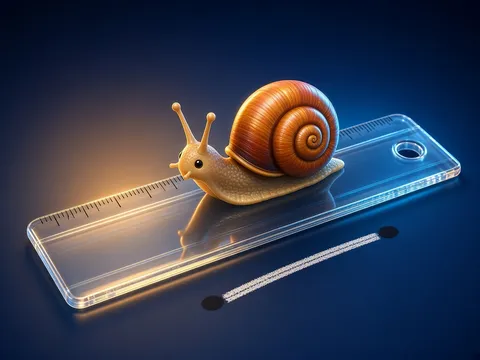
A segment is the part of a straight line between two points. We measure its length in centimetres (cm).
 What the book shows

The textbook usually gives a picture example, a counting or comparing task and a short check. Talk about the picture first, then try the tasks with real objects.
Textbook link:
This is not the textbook’s text but a short description of the topic. Check the exact page in your own textbook.
 The lesson step by step
- 1
Steps5 min
Measuring the room in steps: results differ!
- 2
Centimetre10 min
One unit for all.
- 3
Measuring10 min
Starting at 0.
- 4
Drawing10 min
3, 5, 7 cm segments.
- 5
Wrap-up5 min
Why from 0?
 Let’s understand
For the student Simple language
The snail crawls along the ruler. Below is a line between two points: a segment.
A centimetre (cm) is the gap between two neighbouring numbers on a ruler.
How to measure
- Put the ruler’s 0 at one end of the segment.
- Look at the other end: which number is it at?
- Say: “The segment is 5 cm long.”
 For the parent
How to help
- Measure pencils, a spoon, a finger.
- Guess first, then measure: who was closer?
- Check: does the ruler start at 0?
 For the teacher
 Lesson goals
- Segments; measuring and drawing in cm.
How to teach it
- Informal units, rulers, pairs.
 Differentiation
- Fast finishers: adding two segments.
 Questions for the class
- Why are steps not exact?
 How to check
The pupil measures and draws 3 segments to within 1 cm.
 Scientific Scientific language
A standard unit
Length can first be measured with informal units (steps, hand spans, cubes), but everyone gets different results. So we need one shared unit: the centimetre. 100 centimetres make 1 metre. A ruler is a number line, so measuring starts at 0.
Self-study
Step by step
- Put the ruler’s 0 at one end.
- Keep the ruler straight along the segment.
- Read the number at the other end and add “cm”.
 Terms in this lesson
Tap an underlined word — its meaning opens in the glossary.
- Number
- Shows how many things there are.
- Number line
- A line with numbers in order.
- Sum
- The result of addition.
- Side
- A straight edge of a shape.
Going deeper
 Scientific language: for older students, parents and teachers.
The metric system was created in France at the end of the 18th century; “centimetre” means “a hundredth of a metre”. Most countries use it today, Azerbaijan included.
The main measuring mistake is starting the ruler at 1 or at its edge instead of 0. Counting centimetres as “steps” helps: 0 to 1 is the first step, 1 to 2 the second.
 Play and check
Is this a segment?
 How to write it down
- Draw segments 3 cm, 5 cm and 7 cm long.
- Label each with its length.
How the classwork looks in the notebook
Sample: the date and heading follow this country’s notebook rules.
 Watch out: common mistakes
 Where it helps in life
 At home
Core
- Measure 3 things at home and write it down.
- Draw a 4 cm segment.
Challenge ⭐
- Draw 3 cm and 4 cm segments end to end. How many cm altogether?
How to do it
- Start the ruler at 0.
- Write “cm” in the answer.
Answers for parents
⭐ 3 cm + 4 cm = 7 cm.
Step-by-step homework solution — Show the solution (try it yourself first)
Draw a given length
- Mark a point at 0 and another at the number you need, then join them.
How the homework looks in the notebook
Sample: the date and heading follow this country’s notebook rules.

 About cookies