


Clock: o’clock


 About this lesson
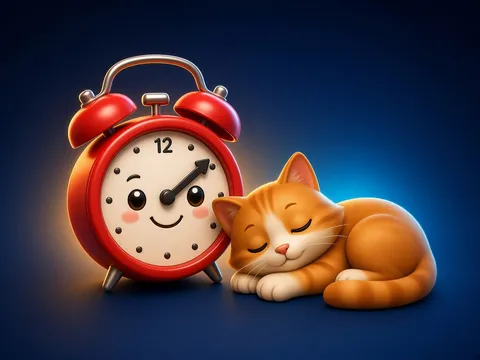
A clock has two hands: the short one shows hours, the long one minutes. When the long hand is on 12, it’s o’clock.
 What the book shows

The textbook usually gives a picture example, a counting or comparing task and a short check. Talk about the picture first, then try the tasks with real objects.
Textbook link:
This is not the textbook’s text but a short description of the topic. Check the exact page in your own textbook.
 The lesson step by step
- 1
My day5 min
Morning, afternoon, evening, night.
- 2
The hands10 min
Short and long.
- 3
Reading10 min
O’clock times.
- 4
Paper clock10 min
Everyone sets a time.
- 5
Wrap-up5 min
What time do you go to bed?
 Let’s understand
For the student Simple language
The cat sleeps next to the alarm clock. It’s about to ring!
The long hand shows minutes.
If the long hand is on 12, it is o’clock. The number the short hand points to is the hour.
Short hand on 3, long hand on 12 → 3 o’clock.
Through the day
8 o’clock: off to school. 1 o’clock: lunch. 9 o’clock: bedtime.
 For the parent
How to help
- Hang a clock with hands at home and often ask “What time is it?”
- Link routines to times: “Dinner is at 7.”
- Make a clock from a paper plate.
 For the teacher
 Lesson goals
- Reading o’clock times.
How to teach it
- Paper clocks, daily routine.
 Differentiation
- Fast finishers: “in 3 hours”.
 Questions for the class
- Why does a clock show 12 numbers, not 24?
 How to check
The pupil reads 4 of 5 clocks correctly.
 Scientific Scientific language
Understanding time
Time is invisible, which makes it hard for children. First comes the order of the day (morning, afternoon, evening, night), then the hands. A clock face has 12 numbers; the short hand goes round twice a day, since a day has 24 hours.
Self-study
Step by step
- Look at the long hand: is it on 12?
- Read the number at the short hand.
- Say: “… o’clock”.
 Terms in this lesson
Tap an underlined word — its meaning opens in the glossary.
- Number
- Shows how many things there are.
Going deeper
 Scientific language: for older students, parents and teachers.
Splitting the day into 24 hours goes back to ancient Egypt, and the 60-minute hour to the base-sixty system of ancient Babylon. The short hand goes round twice a day; the long hand goes round once an hour.
The word “clockwise” comes from this movement.
 Play and check
Is it o’clock?
 How to write it down
- Draw a circle and write 12, 3, 6, 9.
- Show 3 o’clock: short hand to 3, long hand to 12.
How the classwork looks in the notebook
Sample: the date and heading follow this country’s notebook rules.
 Watch out: common mistakes
 Where it helps in life
- Grade 2: half hours and minutes.
- Life: school timetable, bus times.
 At home
Core
- Draw 3 clocks: 7, 12 and 5 o’clock.
Challenge ⭐
- It is 2 o’clock. What time will it be in 3 hours?
How to do it
- Draw the long hand long and the short hand short.
- Start from the centre.
Answers for parents
⭐ 5 o’clock.
Step-by-step homework solution — Show the solution (try it yourself first)
Set the clock
- Long hand to 12 first, then the short hand to the right number.
How the homework looks in the notebook
Sample: the date and heading follow this country’s notebook rules.

 About cookies