


Rights and duties

 About this lesson
A right is something every child has: life, education, health, rest, play and a say. A duty is something we must do: study, respect others and look after things.
 What the book shows

The textbook usually gives a big picture, questions and a small observation or project task. Talk about the picture, link the questions to your child’s life and continue the task at home.
Textbook link:
This is not the textbook’s text but a short description of the topic. Check the exact page in your own textbook.
 The lesson step by step
- 1
Picture5 min
Book and watering can.
- 2
Table10 min
Right and duty.
- 3
Game10 min
Which is it?
- 4
Convention10 min
Rights for all.
- 5
Rules5 min
Class agreement.
 Let’s understand
For the student Simple language
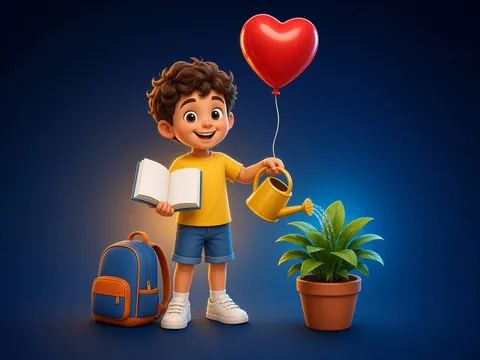
The boy holds a book in one hand: that is his right to education. With the other he waters a plant: that is his duty.
| My right | My duty |
|---|---|
| To learn | To do my homework |
| To be healthy | To keep clean |
| To play and rest | To tidy my toys |
| To give my opinion | To listen to others |
 For the parent
How to help
- Agree on 2–3 regular household jobs together.
- Ask for and listen to your child’s opinion: that is a right too.
- Teach who to go to when something is unfair: a parent or teacher.
 For the teacher
 Lesson goals
- Children’s rights and duties.
How to teach it
- Table, sorting, class rules.
 Differentiation
- Role play: an unfair situation.
 Questions for the class
- Why do rights and duties go together?
 How to check
The pupil names 3 rights and 3 duties.
 Scientific Scientific language
The Convention on the Rights of the Child
In 1989 the UN adopted the Convention on the Rights of the Child, and Azerbaijan joined it in 1992. Under the Convention everyone under 18 is a child. 1 June is International Children’s Day.
Self-study
Step by step
- Is it something I am given, or something I must do?
- Given means a right; a job means a duty.
- Write it in the table.
Going deeper
 Scientific language: for older students, parents and teachers.
The Convention on the Rights of the Child is one of the human rights treaties joined by the most countries. Its key idea is that a child’s best interests come first in every decision.
 Play and check
Right or duty?
 How to write it down
- Draw two columns, “My rights” and “My duties”, and write 3 examples in each.
How the classwork looks in the notebook
Sample: the date and heading follow this country’s notebook rules.
 Watch out: common mistakes
 Where it helps in life
- Year 4: being a citizen and the Constitution.
 At home
Core
- Choose 3 jobs at home with your family and tick them off for a week.
Creative ⭐
- Draw a poster: “Every child has rights”.
How to do it
- Choose jobs with your family.
- Tick them every day.
Answers for parents
For example: clearing dishes, making the bed, watering plants.
Step-by-step homework solution — Show the solution (try it yourself first)
Class rules
- Write 5 class rules together, each with a right and a duty (“Everyone may speak, so we take turns”).
How the homework looks in the notebook
Sample: the date and heading follow this country’s notebook rules.

 About cookies