


Living and non-living nature


 About this lesson
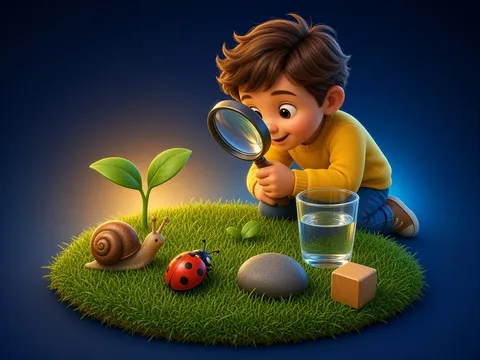
Living things feed, breathe, grow, reproduce and die: plants, animals, fungi and people. Non-living nature is stone, water, air, the Sun and soil. Living things cannot survive without non-living nature.
 What the book shows

The textbook usually gives a big picture, questions and a small observation or project task. Talk about the picture, link the questions to your child’s life and continue the task at home.
Textbook link:
This is not the textbook’s text but a short description of the topic. Check the exact page in your own textbook.
 The lesson step by step
- 1
Magnifier5 min
What do we see?
- 2
Signs10 min
Four signs.
- 3
Game10 min
Living or not.
- 4
Object10 min
Made by people.
- 5
Experiment5 min
Sprouting a bean.
 Let’s understand
For the student Simple language
The boy looks through a magnifier: the sprout, the snail and the ladybird are living. The stone and the glass of water are non-living nature. The wooden block was made by people, so it is an object, not nature.
✔ it feeds ✔ it breathes ✔ it grows ✔ it reproduces
 For the parent
How to help
- On a walk, find 5 living and 5 non-living things.
- Sprout a bean and watch it grow every day.
- Ask: “Does it grow? Does it feed?”
 For the teacher
 Lesson goals
- Signs of life.
How to teach it
- Observation, sorting, experiment.
 Differentiation
- Stronger pupils: fire and clouds.
 Questions for the class
- Why is one sign not enough?
 How to check
The pupil sorts 8 objects correctly.
 Scientific Scientific language
All the signs together
One sign is not enough: clouds “grow” and fire “moves”, but they are not alive. Living things show all the signs together. Plants breathe and feed too: in light they make food in their leaves.
Self-study
Step by step
- Does it feed? Breathe?
- Does it grow? Reproduce?
- All yes means it is alive.
Going deeper
 Scientific language: for older students, parents and teachers.
Some living things live a very long time: some pine trees in the USA are more than 4,000 years old. Others live a very short time: an adult mayfly may live only a few hours or a day.
 Play and check
Living or non-living?
 How to write it down
- Two columns, “Living” and “Non-living”, 5 examples each.
- Draw a sprout.
How the classwork looks in the notebook
Sample: the date and heading follow this country’s notebook rules.
 Watch out: common mistakes
 Where it helps in life
- Water and how to protect it.
- Year 3: food chains.
 At home
Core
- Sprout a bean on cotton wool and draw it every day for 5 days.
Challenge ⭐
- Why is fire not alive? Give 2 reasons.
How to do it
- Keep the cotton wool damp.
- Draw it every day.
Answers for parents
Challenge: fire does not feed or breathe like a living thing; it only burns while there is fuel, and it has no young.
Step-by-step homework solution — Show the solution (try it yourself first)
Walk list
- Find 10 things in the park and mark each: living, non-living nature or made by people.
How the homework looks in the notebook
Sample: the date and heading follow this country’s notebook rules.

 About cookies