


Water and how to protect it


 About this lesson
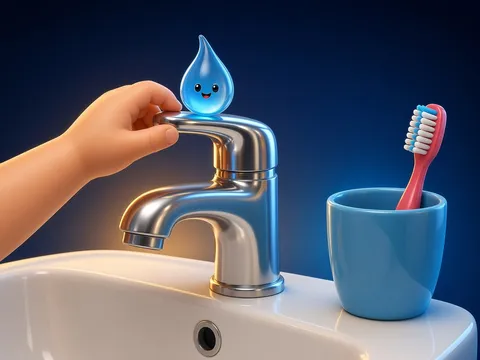
No living thing can survive without water. Earth has lots of water, but most of it is salty sea water; fresh drinking water is scarce. So we must save water and keep it clean.
 What the book shows

The textbook usually gives a big picture, questions and a small observation or project task. Talk about the picture, link the questions to your child’s life and continue the task at home.
Textbook link:
This is not the textbook’s text but a short description of the topic. Check the exact page in your own textbook.
 The lesson step by step
- 1
Drop5 min
Why is it happy?
- 2
Water cycle10 min
Vapour, cloud, rain.
- 3
Game10 min
Protects or harms.
- 4
Our waters10 min
Caspian, Kura.
- 5
Pledge5 min
My rule.
 Let’s understand
For the student Simple language
The child turns off the tap while brushing their teeth. The water drop is happy: it wasn’t wasted!
How can we save water?
- Turn off the tap while brushing your teeth.
- Take a short shower instead of a bath.
- Tell a grown-up about a dripping tap.
- Water plants in the evening, when less evaporates.
 For the parent
How to help
- Put a bowl under a running tap for one minute: how much collects?
- Give your child the job of “water keeper” at home.
- Show by example: no litter by rivers or the sea.
 For the teacher
 Lesson goals
- Why water matters and how to protect it.
How to teach it
- Experiment, sorting, poster.
 Differentiation
- Class “water keepers”.
 Questions for the class
- Why can’t we drink sea water?
 How to check
The pupil names 4 ways to save water.
 Scientific Scientific language
The water cycle
The Sun warms water, it evaporates and forms clouds, then falls as rain and snow and flows back to the sea in rivers. About 97 per cent of Earth’s water is salty. 22 March is World Water Day.
Self-study
Step by step
- Is water being wasted?
- Is water being polluted?
- Choose: saves or harms.
Going deeper
 Scientific language: for older students, parents and teachers.
Part of Baku’s drinking water comes from distant mountain sources and the Kura. For example, the Oghuz–Gabala pipeline brings underground water from the foothills to the capital. Every drop from the tap has travelled a long way thanks to many people’s work.
 Play and check
Does this protect water?
 How to write it down
- Write 4 ways to save water.
- Draw the water cycle.
How the classwork looks in the notebook
Sample: the date and heading follow this country’s notebook rules.
 Watch out: common mistakes
 Where it helps in life
- Year 3: protecting nature.
- Later years: properties of water and ecology.
 At home
Experiment
- Put a bowl under the tap while brushing, then repeat with the tap off. Compare.
Creative ⭐
- Draw a “Save water!” poster.
How to do it
- Do the experiment with a grown-up.
- Draw the result.
Answers for parents
With the tap off there is much less water in the bowl: that is the water saved.
Step-by-step homework solution — Show the solution (try it yourself first)
Home water map
- Where is water used at home? Kitchen, bathroom, garden. Find a saving rule for each place.
How the homework looks in the notebook
Sample: the date and heading follow this country’s notebook rules.

 About cookies